
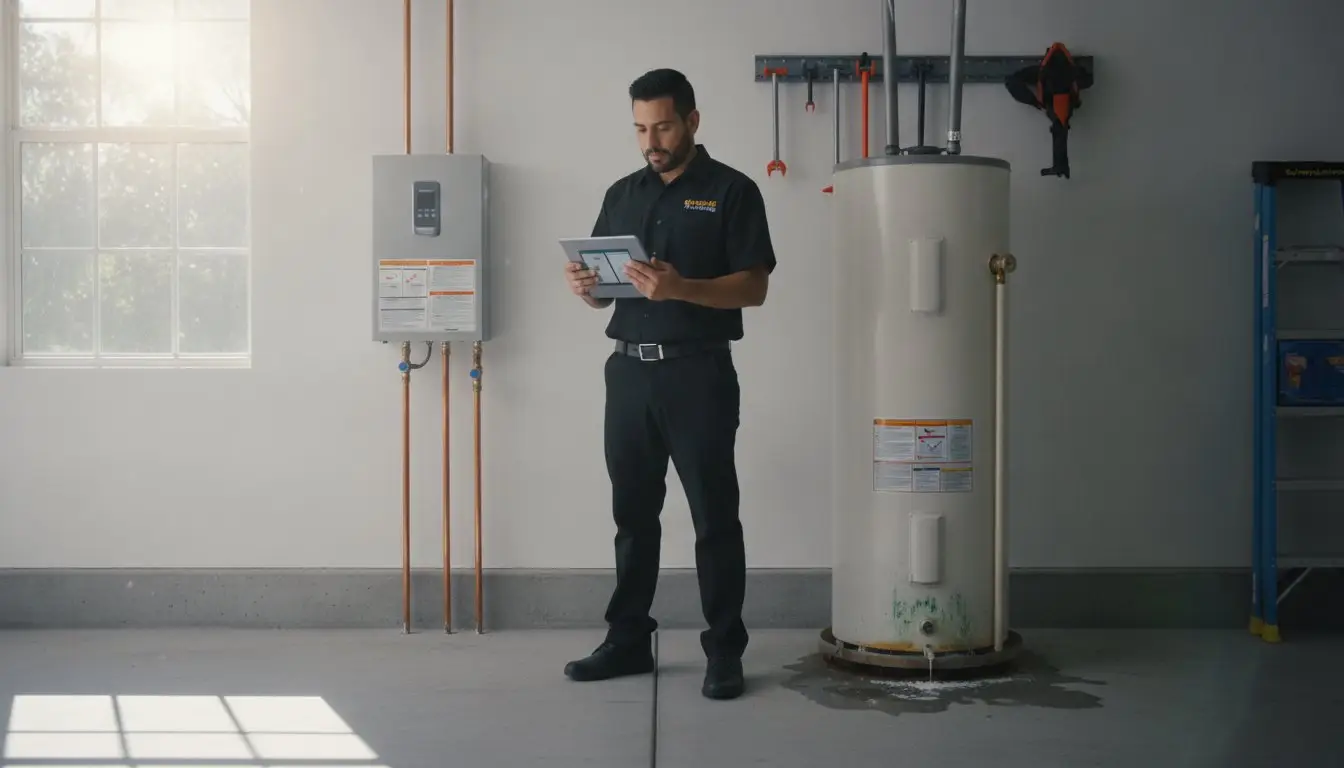
In the Treasure Coast, your water heater fights a constant battle against aggressive mineral scale and high humidity that can cut a traditional tank’s life down to just eight years. Choosing between a tankless water heater vs tank Florida setup isn’t just about the initial price. It’s about whether you want a system that lasts two decades or one that leaves you with a flooded garage in the middle of a Stuart summer. We understand the frustration of high electric bills and the sudden shock of a cold shower when you have a house full of guests in Port St. Lucie or Jensen Beach.
This 2026 guide helps you decide which system maximizes your home’s efficiency and handles our unique hard water challenges best. You’ll discover how tankless units offer a 20-year lifespan and up to $200 in annual energy savings compared to traditional models. We also break down the latest local utility rebates and explain why the upcoming Florida Building Code changes might influence your choice for a more reliable, long-term solution. Whether you are in Fort Pierce or Palm City, these insights ensure your family stays comfortable without overpaying for monthly utilities.
Key Takeaways
- Learn how Florida’s naturally warm groundwater reduces the energy required for heating, making high-efficiency systems even more effective in the Treasure Coast.
- Compare the total cost of ownership for a tankless water heater vs tank Florida installation, factoring in local utility rebates and the upcoming 2026 building code updates.
- Discover how to shield your home from the “burst tank” risk that often plagues aging units in hot Florida garages.
- Understand the maintenance requirements needed to protect your investment from the corrosive effects of Florida’s mineral-heavy hard water.
- Identify which system fits your family’s specific hot water demand to ensure you never run out during guest visits or peak morning hours.
The Florida Advantage: How Our Climate Impacts Water Heater Performance
Living on the Treasure Coast changes the math for home appliances. While homeowners in northern states struggle with freezing pipes, those of us in Port St. Lucie and Stuart deal with high humidity and intense heat. These factors play a massive role when comparing a tankless water heater vs tank Florida installation. Our climate actually makes certain systems perform better than they would anywhere else in the country.
Groundwater Temperature and the ‘Rise’ Factor
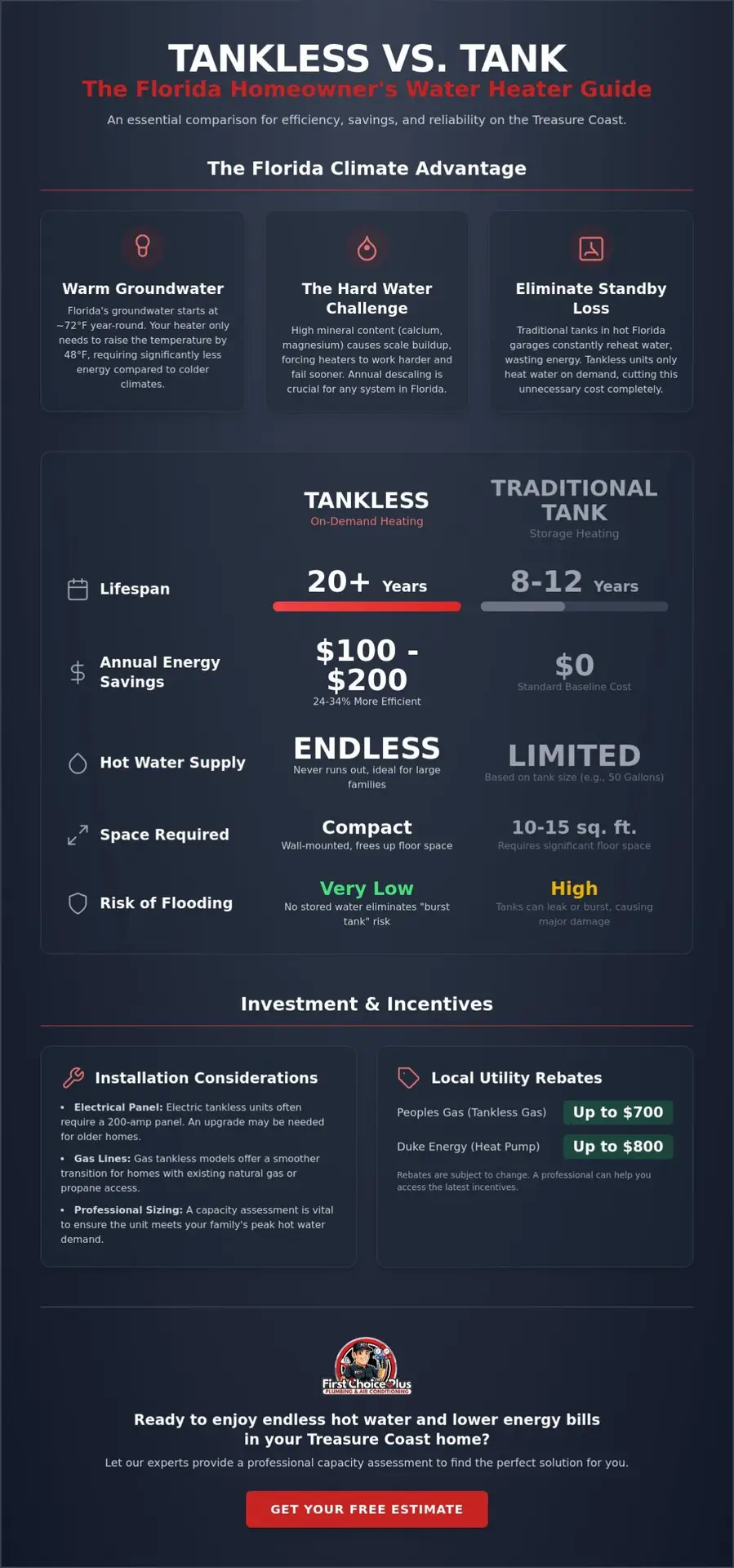
The “temperature rise” is the difference between the water entering your home and your desired shower temperature. In Florida, our groundwater typically stays around 72 degrees year-round. To reach a standard 120 degrees, your system only needs to provide a 48-degree rise. Because the workload is so much lower than in cold climates, smaller and more affordable tankless units can easily provide a high flow rate for multiple showers at once. Understanding how tankless water heaters work reveals why they are so efficient here; they don’t have to fight against ice-cold inlet temperatures.
Hard Water: The Silent Killer of Florida Water Heaters
Florida is known for “hard” water, which is packed with calcium and magnesium. In a traditional tank, these minerals settle at the bottom, creating a thick layer of sediment that acts as an insulator. This forces your heater to run longer and hotter, eventually causing the metal to fatigue and leak. While tankless units are more compact, their copper heat exchangers are sensitive to this same scale. Homeowners in Jensen Beach or Palm City should know that while tankless systems are superior, they require annual descaling to prevent Florida minerals from clogging the narrow internal pathways. Without this simple maintenance, even the best tankless water heater vs tank Florida comparison ends in premature failure.
Finally, consider “standby loss.” If you keep a traditional tank in a 95-degree garage in St. Lucie West or Tradition, the unit works overtime to maintain its internal temperature against the ambient heat. Tankless models eliminate this waste by only heating water when a faucet actually opens, ensuring you aren’t paying to keep 50 gallons of water hot while you’re at work or sleeping.
Comparing Efficiency, Lifespan, and Total Cost of Ownership
A standard storage tank in a Florida garage typically lasts between 8 and 12 years before the internal lining fails. In contrast, a tankless system offers a 20-year lifespan, effectively doubling your investment’s longevity. Reclaiming 10 to 15 square feet of floor space is another major win for homeowners in crowded Port St. Lucie garages. The “endless hot water” promise is a major draw for large families, but flow rates still matter. A single unit provides a steady stream, though running three showers simultaneously requires a properly sized system to maintain pressure.
According to Energy efficiency statistics from the U.S. Department of Energy, homes using 41 gallons or less of hot water daily can see 24% to 34% better efficiency with tankless models. This translates to roughly $100 to $200 in annual savings on your utility bills. These savings are particularly noticeable in the Treasure Coast, where our high usage for laundry and showers keeps heaters running year-round.
Installation Requirements: Electrical vs. Gas
Upgrading to an electric tankless unit often requires a 200-amp electrical panel to handle the high momentary draw. If your home in St. Lucie West or Tradition currently has a 100-amp or 150-amp service, you might need an upgrade. For those with access to natural gas or propane, the transition is often smoother. We recommend scheduling a professional capacity assessment to ensure your home’s infrastructure can support the upgrade without unexpected costs.
Long-Term Savings and 2026 Rebates
Federal tax credits for water heaters expired at the end of 2025, but Florida homeowners can still access significant local incentives. Duke Energy offers up to $800 in rebates for qualifying heat pump water heaters, while Peoples Gas provides up to $700 for those switching to tankless gas models. These savings, combined with a shorter 8 to 12-year payback period, make the tankless water heater vs tank Florida decision much easier for long-term residents. If you’re noticing your current tank is acting up, exploring local plumbing offers can help offset the initial installation investment.
Making the Choice: Which System is Right for Your Treasure Coast Home?
Deciding on a tankless water heater vs tank Florida upgrade often comes down to risk management. In areas like Stuart and Fort Pierce, many traditional tanks sit in unconditioned garages where heat accelerates corrosion. When these units reach the end of their lifespan, they don’t just stop working; they often rupture. This leads to sudden, expensive emergency plumbing repairs that could have been avoided with a proactive switch. While a tankless model requires a higher initial investment, it removes the threat of a 50-gallon flood in your home.
Usage profiles matter just as much as the equipment. A traditional tank might still make sense for a single occupant with very low demand. However, U.S. Department of Energy efficiency data shows that for most households, the energy waste from keeping a tank hot 24/7 is significant. You must also be honest about maintenance. If you live in Jensen Beach or Palm City, the hard water minerals will eventually clog a tankless heat exchanger. Committing to an annual descaling service is the only way to ensure your system actually lasts the promised 20 years.
The Best Fit for Port St. Lucie Households
- Scenario A: The Tradition Family. If you have a growing family in Tradition or St. Lucie West, you likely deal with the “morning rush.” A tankless system ensures the fourth person in the shower has the same hot water as the first.
- Scenario B: The Seasonal Resident. For snowbirds in Hutchinson Island, a tankless unit is ideal. It prevents “stagnant tank” issues where water sits and breeds bacteria while you are away for months at a time.
When to Call a Professional for a System Audit
Don’t wait for a flood to take action. If you notice rusty water, strange popping noises from your garage, or lukewarm temperatures during your morning shower, your current system is likely failing. Our team at First Choice Plus Plumbing & Air evaluates your home’s specific plumbing and electrical readiness to see if a tankless conversion is viable. We provide a clear, honest assessment of your infrastructure so you can make an informed decision for your family’s comfort. Contact First Choice Plus for a water heater consultation to find the right fit for your Treasure Coast home.
Protect Your Treasure Coast Home with the Right Hot Water Solution
Deciding on a tankless water heater vs tank Florida setup is a major step toward improving your home’s efficiency and safety. We’ve seen how Florida’s warm groundwater makes tankless systems incredibly effective, provided you stick to a simple descaling schedule to manage our hard water. Whether you want to reclaim garage space or ensure your family never runs out of hot water during guest visits, the right choice depends on your specific household demand and long-term goals.
Our team at First Choice Plus Plumbing & Air brings years of local expertise to every home in Port St. Lucie and Stuart. We offer 24/7 emergency service and honest, transparent pricing with no hidden fees. We understand both tank and tankless technologies inside and out, ensuring you get a system that fits your budget and your lifestyle perfectly. When you’re ready to make the switch or just need an expert opinion on your current unit’s health, we’re here to help with a steady hand and professional advice.
Schedule a Professional Water Heater Consultation Today and enjoy the peace of mind that comes with a reliable, expert installation. We look forward to keeping your home comfortable for years to come.
Common Questions About Florida Water Heaters
Do tankless water heaters work well with Florida’s hard water?
Yes, tankless units work excellently in Florida, but they are more sensitive to mineral buildup than traditional tanks. Our local water is rich in calcium and magnesium, which can create scale on the heat exchanger. To prevent this, you must commit to an annual descaling service. Many Treasure Coast homeowners also install a water softener to protect their investment and ensure the unit reaches its full 20-year lifespan.
Will I need to upgrade my electrical panel for a tankless water heater in Port St. Lucie?
Many older homes in Port St. Lucie require an upgrade to a 200-amp panel to support a whole-home electric tankless unit. These systems pull a significant amount of electricity instantly to heat water on demand. If your current panel is only 100 or 150 amps, it won’t have the capacity to handle the heater alongside your AC and appliances. We always perform a load calculation to ensure your home is safe.
How much can I actually save on my Florida electric bill with tankless?
You can typically save between $100 and $200 per year on energy costs when comparing a tankless water heater vs tank Florida installation. Because tankless models only heat water when you turn on a faucet, they eliminate the “standby loss” of keeping 50 gallons hot in a humid garage. For homes using 41 gallons of hot water or less daily, these units are often 24% to 34% more energy-efficient.
Is it better to install my water heater in the garage or inside the house in Florida?
The garage is the most practical location for most Treasure Coast homes because it reclaims indoor square footage and provides easier drainage. Installing a tankless unit in the garage also simplifies venting for gas models and keeps the unit’s operating sounds away from living areas. While Florida garages get hot, tankless units aren’t affected by ambient temperatures nearly as much as traditional tanks, which must work harder to stay cool.

Article by
Written by First Choice Plus Plumbing & Air Team
This article was created by the team at First Choice Plumbing Solutions, a licensed and experienced plumbing and HVAC company serving Port St. Lucie, Land O’ Lakes, and surrounding areas.
Our team specializes in plumbing and air conditioning services, including drain cleaning, leak detection, water heater repair and installation, AC repair, maintenance, and system installations. Our content is based on real-world experience and the common issues we solve for homeowners and businesses every day.
We aim to provide accurate, helpful, and easy-to-understand information so you can make informed decisions about your plumbing and HVAC needs.
If you need reliable, professional service, First Choice Plumbing Solutions is here to help.
Disclaimer
Disclaimer: The information provided in this article is for general informational purposes only and does not constitute professional plumbing or HVAC advice. Every situation is different, and readers should consult a licensed professional for proper diagnosis and repair. First Choice Plus Plumbing & Air is not liable for any damages or losses resulting from the use of this information.