
If you are looking at a sizing chart designed for a home in the Midwest, you are likely about to spend hundreds of dollars on a machine you don’t actually need. Many homeowners in Port St. Lucie fear under-sizing their equipment and running out of hot water, but the “Florida factor” changes the math entirely. Because our local groundwater on the Treasure Coast stays at a warm 70 to 75 degrees, your unit doesn’t have to work nearly as hard to reach a comfortable temperature. This tankless water heater sizing guide simplifies the technical jargon to help you find the exact Gallons Per Minute (GPM) required for your specific lifestyle.
It’s frustrating to stare at spec sheets filled with terms like “temperature rise” when you just want to know if you can run the dishwasher and the shower at the same time. We’ll show you how to calculate your peak hot water demand so you can shop with confidence and avoid the “cold shock” surprise. You will also learn how to check if your current electrical panel or gas lines can handle the load before you commit to an installation. From Stuart to Fort Pierce, we are here to ensure your transition to tankless is smooth, efficient, and perfectly sized for your Florida home.
Key Takeaways
- Learn how to calculate your home’s total Gallons Per Minute (GPM) by identifying your household’s peak “simultaneous demand” for hot water.
- Discover why the naturally warm groundwater on the Treasure Coast allows you to use a smaller, more cost-effective unit than homeowners in colder climates.
- Use this tankless water heater sizing guide to determine if your existing gas lines or electrical service can handle the high-volume needs of a tankless system.
- Master the math behind “Temperature Rise” to ensure your water consistently reaches your desired set point without a drop in performance.
- Find out how to balance your family’s daily hot water habits with the right equipment to maximize both comfort and monthly energy savings.
The Fundamentals of Tankless Sizing: Gallons Per Minute (GPM)
When you switch from a traditional tank to a tankless system, you have to change how you think about capacity. Instead of a 50-gallon reservoir of hot water sitting in your garage, a tankless unit acts more like a high-speed processor. It heats water on demand as it moves through the system at a specific flow rate. This makes Gallons Per Minute (GPM) the critical metric for tankless performance in 2026. This tankless water heater sizing guide focuses on flow rate because that determines how many things you can do at once without losing heat.
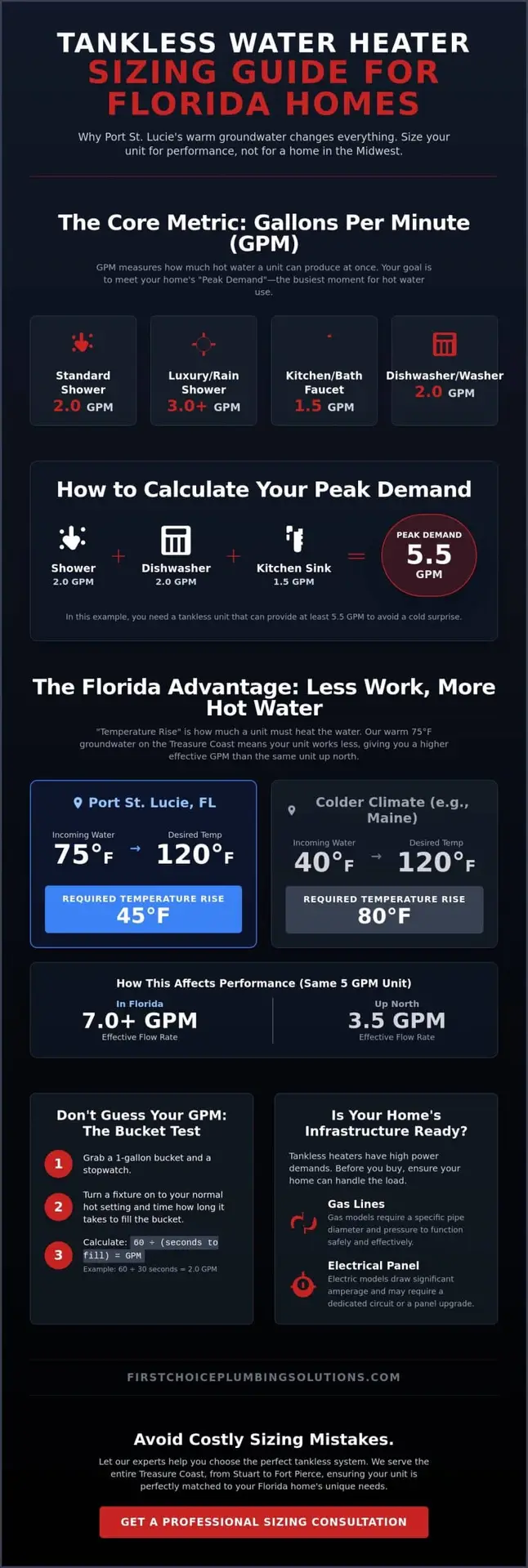
We call this “Simultaneous Demand.” If you are showering while the dishwasher is running, your unit must be powerful enough to handle the combined flow of both fixtures. Tankless water heating technology has advanced significantly, but it still has physical limits based on its GPM rating. Here is a look at what typical fixtures in a Port St. Lucie home require:
- Standard low-flow showerhead: 2.0 GPM
- Luxury rain shower or multi-head system: 3.0+ GPM
- Kitchen or bathroom faucet: 1.5 GPM
- Dishwasher or washing machine: 1.5 to 2.5 GPM
Step-by-Step: Calculating Your Peak Demand
Start by walking through your home in Traditions or St. Lucie West and count your fixtures. Don’t just count every sink; think about your busiest morning. If two people shower at the same time while the kitchen sink is in use, your target flow rate is the sum of those three fixtures. Adding 2.0 + 2.0 + 1.5 gives you a peak demand of 5.5 GPM. Choosing a unit that meets this specific number ensures you never experience a sudden temperature drop during your morning routine.
The “Bucket Test” for Existing Fixtures
Don’t guess your flow rate and risk over-buying an expensive, oversized unit. Grab a one-gallon bucket and a stopwatch. Turn your shower on to its normal hot setting and time how long it takes to fill the bucket. If it takes 30 seconds, your shower is running at 2.0 GPM. If it takes 20 seconds, you have a high-flow 3.0 GPM fixture. This real-world data is the most accurate part of any tankless water heater sizing guide. If you need help interpreting these results, our team at First Choice Plus Plumbing & Air can verify your home’s needs during a professional inspection to ensure your new system is perfectly matched to your lifestyle.
The Florida Factor: Why Temperature Rise Matters in Port St. Lucie
Temperature rise is the difference between the cold water entering your home and the hot water coming out of your faucet. Most homeowners prefer their water at roughly 120°F. In many parts of the country, groundwater can be as cold as 40°F, requiring a massive 80-degree jump in temperature. This is where a standard tankless water heater sizing guide often fails Florida residents. On the Treasure Coast, our groundwater averages a balmy 72°F to 77°F. Because the unit only needs to add about 45 to 50 degrees to reach your target, it can process water much faster than it would in a colder climate.
This “Florida Advantage” means a unit that struggles to provide two showers in Maine might easily handle three showers and a dishwasher in St. Lucie West or Tradition. When the required temperature rise is lower, the GPM capacity of the unit effectively increases. Understanding this relationship is a core part of Sizing a New Water Heater for maximum efficiency and comfort.
Florida vs. The North: Sizing Comparison
The following table shows how the same 5 GPM tankless unit performs differently based on the incoming water temperature. Notice how the Florida home gets nearly double the effective flow rate.
| Location | Incoming Water | Required Rise | Effective Flow (GPM) |
|---|---|---|---|
| Port St. Lucie, FL | 75°F | 45°F | 7.0+ GPM |
| Portland, ME | 40°F | 80°F | 3.5 GPM |
Groundwater Fluctuations in the Treasure Coast
While our water is generally warm, we do see minor seasonal shifts. During a rare January cold snap, your groundwater temperature might dip slightly. We always recommend sizing your unit for this “worst-case” scenario to ensure you don’t get a lukewarm shower on the coldest day of the year. Additionally, Florida is known for hard water. Over time, mineral scale can act as an insulator inside your unit, making it harder to achieve the necessary temperature rise. Exploring water quality solutions like a softener can protect your unit’s efficiency. If you’re ready to see which model fits your specific plumbing layout, our team can provide a professional sizing assessment to ensure you never run out of hot water.
Beyond GPM: Infrastructure Requirements for Tankless Systems
Calculating your flow rate is only half the battle. Even the most accurate tankless water heater sizing guide is useless if your home’s infrastructure can’t support the unit’s physical demands. Many homeowners ask if their current pipes can handle the switch. While your water lines are usually fine, your fuel or power sources often require upgrades. A tankless unit doesn’t sip energy slowly; it gulps it all at once to provide that instant heat.
Gas units require a high volume of BTUs to function. If you are switching from a tank to a tankless gas model, your existing 1/2-inch gas line is likely too small. These systems often necessitate a 3/4-inch line to ensure the burner gets enough fuel during peak demand. Venting is another critical factor. You cannot simply reuse the old vent from your tank heater. Modern tankless units have specific venting requirements, often using dedicated PVC or stainless steel pipes to safely move exhaust out of your home. Following the official guide for Sizing Tankless or Demand-Type Water Heaters helps prevent these common installation pitfalls.
When to Consider a Whole-Home Repipe
If your home in Fort Pierce or Jensen Beach still has older galvanized or cast iron pipes, the internal corrosion could be a major bottleneck. No matter how much water your new heater can process, clogged pipes will restrict the flow at the faucet. If you notice low pressure or rusty water, it might be time to look at our repipe and repair guide. Upgrading your plumbing ensures you actually feel the high GPM performance you calculated earlier.
Choosing Between Gas and Electric Tankless
Gas units generally offer higher GPM capacities, making them ideal for larger families. Electric models are popular in many Port St. Lucie neighborhoods because they don’t require venting, but they demand significant electrical panel space. A whole-home electric unit may require multiple 40-amp breakers, which could max out a standard 200-amp panel. We always suggest having a master plumber verify your gas pressure or electrical capacity before you buy. Ready for an upgrade? Contact our water heater experts for a precision tankless water heater sizing guide consultation to ensure your home is ready for the switch.
Enjoy Endless Hot Water in Your Treasure Coast Home
Choosing the right unit doesn’t have to be a technical guessing game. You now know that our warm Florida groundwater gives you a significant advantage, often allowing for higher flow rates than northern households can achieve with the same equipment. By calculating your peak GPM and confirming your gas or electrical infrastructure is ready, you can enjoy the luxury of endless hot water without the fear of an under-sized system. This tankless water heater sizing guide provides the framework, but the final step is ensuring a safe, code-compliant installation that handles our local water conditions.
At First Choice Plus Plumbing & Air, we’ve been locally owned and operated since 2007. We specialize in the expert installation of all major tankless brands and provide 24/7 emergency service throughout Port St. Lucie and Stuart. Whether you are in Palm City, Jensen Beach, or Fort Pierce, our team is ready to help you make the right choice for your family’s long-term comfort. Schedule Your Tankless Sizing Consultation with First Choice Plus today and start experiencing the efficiency of a perfectly sized system.
Frequently Asked Questions
How many GPM does a family of 4 need for a tankless water heater?
A family of four typically requires a unit providing between 5 and 7 GPM to ensure everyone stays comfortable during the morning rush. If two people shower simultaneously while the dishwasher runs, your peak demand hits roughly 5.5 GPM. Since our local groundwater is already warm, most mid-sized units handle this load without any trouble. It’s always best to check your specific fixtures using a tankless water heater sizing guide calculation to avoid any surprises.
Can a tankless water heater run two showers at once in Florida?
Yes, a properly sized tankless unit can easily support two showers at once in Florida due to our high intake temperatures. While a homeowner in a colder state might need a massive unit for this, our 75°F groundwater means the heater only works half as hard. You’ll typically need a unit rated for at least 4.5 GPM to maintain steady heat in both bathrooms without one person getting a cold shock when a second tap opens.
What happens if I buy a tankless water heater that is too small?
Buying a unit that is too small results in lukewarm water or a “cold water sandwich” when multiple fixtures are open at once. Every heater has a maximum BTU output; if the water flow exceeds its heating capacity, the temperature will drop significantly. You won’t necessarily damage the machine, but you’ll lose the primary benefit of going tankless. This is why getting the math right in your tankless water heater sizing guide is vital for long-term satisfaction.
Do I need to upgrade my electrical panel for an electric tankless water heater?
Many Florida homes require an electrical panel upgrade to support the high amperage draw of a whole-home electric tankless model. These units often require three or four dedicated 40-amp breakers, which can easily overwhelm a standard 150-amp or 200-amp service. If your panel is already full or nearing its limit, a gas-powered unit is often a more practical and cost-effective alternative for your Treasure Coast home.
Is a 5 GPM tankless water heater enough for a whole house?
A 5 GPM unit is generally enough for a standard two-bathroom home in areas like St. Lucie West or Jensen Beach. This capacity allows you to run two standard 2.0 GPM showers at the same time with a little room to spare for a bathroom faucet. However, if you have high-flow luxury rain shower heads or a large family, you should consider a 7 GPM or larger model to ensure total comfort during peak usage times.
How does hard water in Port St. Lucie affect tankless sizing?
Hard water in Port St. Lucie creates calcium scale that coats the internal heat exchanger, effectively reducing your unit’s heating efficiency over time. As scale builds up, the unit has to work harder to reach your set temperature, which can lead to a noticeable drop in GPM performance. We recommend annual professional descaling or installing a water softener to keep your system running at the original capacity promised in your sizing guide.

Article by
Written by First Choice Plus Plumbing & Air Team
This article was created by the team at First Choice Plumbing Solutions, a licensed and experienced plumbing and HVAC company serving Port St. Lucie, Land O’ Lakes, and surrounding areas.
Our team specializes in plumbing and air conditioning services, including drain cleaning, leak detection, water heater repair and installation, AC repair, maintenance, and system installations. Our content is based on real-world experience and the common issues we solve for homeowners and businesses every day.
We aim to provide accurate, helpful, and easy-to-understand information so you can make informed decisions about your plumbing and HVAC needs.
If you need reliable, professional service, First Choice Plumbing Solutions is here to help.
Disclaimer
Disclaimer: The information provided in this article is for general informational purposes only and does not constitute professional plumbing or HVAC advice. Every situation is different, and readers should consult a licensed professional for proper diagnosis and repair. First Choice Plus Plumbing & Air is not liable for any damages or losses resulting from the use of this information.