
Did you know that cooling your home can account for up to 60% of your monthly electric bill here in South Florida? With the average residential electricity rate sitting at 15.38¢/kWh, those long summer afternoons can get expensive fast. Most homeowners realize that programming a smart thermostat to save money in Florida is a smart move, yet many struggle to find the right balance between lower costs and a home that feels like a swamp.
It’s a common frustration to see your utility bill spike while you’re still dealing with that “sticky” feeling indoors. You want to save every dollar possible, but you’re likely worried that setting the temperature too high while you’re away might lead to mold issues or damage your property. We’re here to tell you that you can have both a lower bill and a perfectly controlled climate through simple, expert-backed adjustments.
In this guide, we’ll show you how to optimize your settings to achieve 8% to 15% savings on your cooling costs. You’ll learn the specific temperature setpoints recommended by the Department of Energy, how to use humidity sensors to your advantage, and how to automate your comfort so you never have to think about the dial again. Let’s get your home running efficiently and keep your hard-earned money in your pocket.
Key Takeaways
- Discover why 78°F is the ideal setting for Florida homes and how the “1% rule” can significantly lower your cooling costs.
- Master the specific daily schedule for programming a smart thermostat to save money in Florida without compromising your home’s air quality or humidity levels.
- Learn the safe temperature limits for an empty house to prevent mold growth while maximizing energy efficiency during the day.
- Explore how advanced features like geofencing and learning algorithms can automate your savings by adjusting settings based on your real-time location.
- Understand why professional AC maintenance is essential to ensure your thermostat’s sensors are accurate and your system can handle programmed changes.
Why 78°F is the Magic Number for Florida Energy Savings
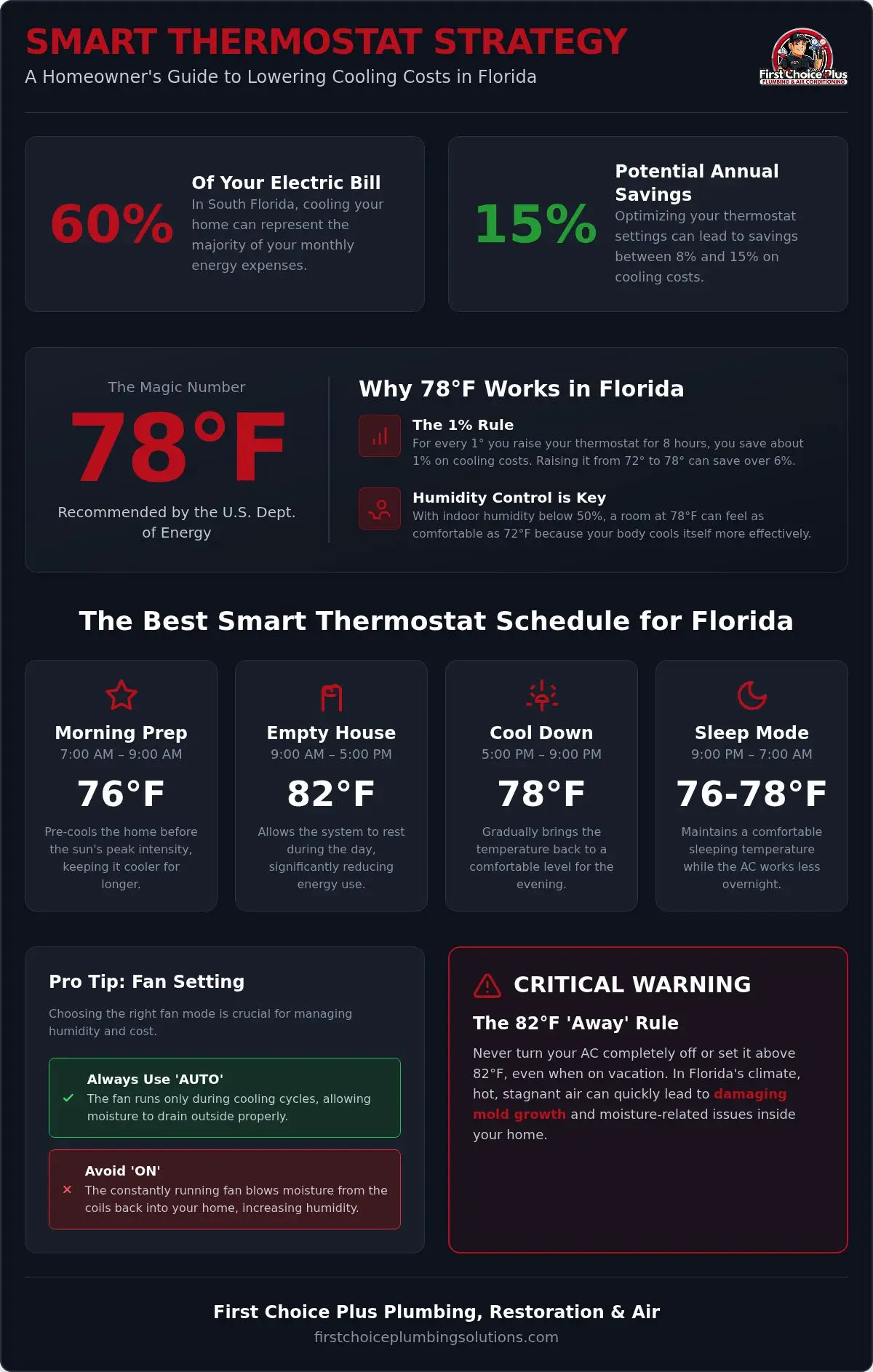
The U.S. Department of Energy and local utilities like Florida Power & Light consistently recommend 78°F as the ideal summer setting. This isn’t a random number. It’s based on the “1% Rule,” which states that for every degree you raise your thermostat for an eight-hour period, you can save roughly 1% on your monthly cooling costs. If you’re currently keeping your home at 72°F, moving that setpoint to 78°F could slash your energy usage by 6% or more. When you’re programming a smart thermostat to save money in Florida, this 78°F benchmark serves as your foundation for maximum efficiency.
Many homeowners worry that 78°F will feel stifling, but the secret lies in humidity control. A modern smart thermostat does more than just track heat; it acts as a command center for your entire indoor climate. When your indoor relative humidity stays below 50%, 78°F actually feels like 72°F because your body can cool itself more effectively. High-end thermostats use “Humidity Sensing” to run the AC specifically to pull moisture from the air, even if the temperature hasn’t quite hit the trigger point yet.
The Relationship Between Temperature and Relative Humidity
Your air conditioner is a dehumidifier first and a cooler second. In the Port St. Lucie summer swelter, the AC must remove gallons of water from the air before you ever feel a drop in temperature. If your home feels “sticky,” your system might be oversized or short-cycling. You can use your thermostat’s “Circulate” mode to move air through your filters and over the cooling coils without constantly running the heavy-duty compressor. This keeps the air fresh and dry without a massive spike in your electric bill.
Why ‘Auto’ is Always Better Than ‘On’
Setting your fan to “On” instead of “Auto” is a common mistake that leads to high bills and humid rooms. When the fan stays on, it continues to blow air over the wet evaporator coils after the cooling cycle ends. This blows the moisture right back into your living space. In high-humidity regions like Stuart and Fort Pierce, this can make your home feel like a sauna within minutes. Keeping the fan on “Auto” ensures that moisture stays on the coils and drains outside where it belongs, protecting your comfort and your wallet.
Step-by-Step: The Best Smart Thermostat Schedule for Florida
Set it and forget it. That’s the goal for any homeowner on the Treasure Coast. However, programming a smart thermostat to save money in Florida requires a strategic approach to the clock. You aren’t just fighting heat; you’re managing the thermal momentum of your home. A well-planned schedule prevents your AC from working in overdrive during the hottest hours of the afternoon.
- Morning Prep (7:00 AM – 9:00 AM): Set your thermostat to 76°F. This slightly pre-cools your home before the sun reaches its peak intensity, helping your walls and furniture stay cool longer into the day.
- Empty House (9:00 AM – 5:00 PM): Shift the setpoint to 82°F. This allows the system to rest while you’re at work, significantly reducing energy consumption without letting the indoor climate spiral out of control.
- The Cool Down (5:00 PM – 9:00 PM): Bring the temperature back down to 78°F. Do this gradually. If your device has a “Smart Recovery” feature, let it handle the transition to avoid a massive power surge at 5:01 PM.
- Sleep Mode (9:00 PM – 7:00 AM): Most residents find 76°F to 78°F comfortable for sleep when paired with a ceiling fan. Since outdoor temperatures drop at night, your AC won’t have to work nearly as hard to maintain these levels.
Managing ‘Away’ Mode Safely to Prevent Mold
You might be tempted to turn the AC off entirely when you head to work, but that’s a mistake. In Florida, we follow the 82°F Rule. Never let your home exceed 82°F, even during a long vacation. Stagnant, hot air quickly becomes a breeding ground for mold and can even lead to moisture-related pipe issues. If you suspect high humidity is already causing hidden problems, it might be time to consult a leak detection expert to ensure your home’s foundation stays dry and secure.
The ‘Recovery Time’ Trap
Many people wait until they walk through the door to “crank it down” to 72°F. This forces a 10-degree drop in a single hour, putting immense strain on your air handler and compressor. Instead, use the “Early Start” features found in most modern units. These algorithms learn exactly how long your specific home takes to cool down, starting the process 30 minutes early so you arrive to a comfortable home without stressing the hardware. If your system struggles to meet these programmed changes, a quick emergency AC repair check-up can identify failing sensors before they cause a full breakdown.
Leveraging Advanced Smart Features for Maximum ROI
Modern devices offer much more than a digital clock. To truly master programming a smart thermostat to save money in Florida, you should utilize the automation features that remove human error from the equation. These tools ensure your system only works when it needs to, protecting both your comfort and your bank account.
- Geofencing: This is a game-changer for Treasure Coast commuters. By using your phone’s GPS, your thermostat can automatically trigger “Away” mode the moment you cross the Roosevelt Bridge or leave the Tradition area. You never have to worry about forgetting to adjust the dial before work again.
- Learning Algorithms: Many top-tier thermostats study your daily habits. If you consistently lower the temperature at 10:00 PM, the device learns this pattern and eventually automates it. This eliminates manual programming errors that often lead to wasted energy.
- Utility Demand Response: Residents in Port St. Lucie can take advantage of programs like FPL’s On Call or Duke Energy’s EnergyWise. These programs provide annual bill credits, often ranging from $90 to $141 per year, in exchange for allowing the utility to make minor, unnoticeable adjustments during peak load periods.
- Maintenance Alerts: Your thermostat acts as a diagnostic tool. It can warn you about a clogged filter or a system malfunction before it escalates into a costly emergency AC repair.
When Smart Programming Can’t Solve High Bills
If your utility bills remain stubbornly high despite perfect settings, the problem likely isn’t the thermostat. Leaky ductwork or an aging air handler can force your system to run significantly longer than necessary just to reach your target temperature. Scheduling a professional AC tune-up is the only way to ensure your hardware is actually capable of following the smart commands you’ve programmed. We can verify that your sensors are reading accurately and that your system is operating at peak efficiency.
Placement Matters: The ‘Ghost’ Reading Problem
A thermostat is only as smart as the data it receives. If your controller is mounted near a hot kitchen or a sunny window in Palm City, it will suffer from “ghost readings.” These false heat spikes trick the AC into thinking the whole house is hot, leading to over-cooling and wasted money. For larger Treasure Coast homes, we recommend installing remote sensors. These small devices sit in bedrooms or living areas and average out the readings, giving your system a much more accurate picture of your home’s actual climate.
Take Control of Your Treasure Coast Cooling Costs
Mastering the balance between comfort and cost is essential for every Florida homeowner. By sticking to the 78°F benchmark and utilizing automation like geofencing, you can finally stop worrying about high utility bills. Remember that your thermostat is only as effective as the air conditioner it controls. If your unit is struggling with leaks or dirty coils, even the best schedule won’t deliver the savings you expect. Programming a smart thermostat to save money in Florida works best when your hardware is in peak condition.
At First Choice Plus, we bring family-owned local reliability and expert smart thermostat integration to every job. Our team provides 24/7 emergency service across the Treasure Coast to ensure you’re never left in the heat. Ready to maximize your home’s efficiency? Schedule a professional AC tune-up with First Choice Plus today! We’ll verify your system’s health and make sure your smart settings are actually working for you. You deserve a home that’s both cool and affordable.
Frequently Asked Questions
What is the best thermostat setting for Florida in the summer?
The U.S. Department of Energy recommends setting your thermostat to 78°F when you are at home. This temperature provides the best balance between monthly savings and indoor comfort. If this feels too warm at first, try using ceiling fans to create a wind-chill effect, which can make the room feel up to 4 degrees cooler while using a fraction of the energy of your AC unit.
Is it cheaper to leave the AC at one temperature or turn it up when I leave?
It is much cheaper to raise the temperature by 7 to 10 degrees when you are away for eight hours or more. The myth that your AC works harder to cool a warm house is incorrect; your system actually loses less energy when the indoor temperature is closer to the outdoor heat. Programming a smart thermostat to save money in Florida ensures these adjustments happen automatically so you never return to a sweltering house.
How do I use my smart thermostat to control humidity in Florida?
You should enable the “Humidity Sensing” or “Overcool to Dehumidify” feature found in most smart models. This allows the air conditioner to run specifically to pull moisture from the air, even if the temperature has already reached your setpoint. Keeping your relative humidity below 50% is the most effective way to stay comfortable at higher temperatures and reduce the overall load on your system.
Can a smart thermostat help prevent mold in my Port St. Lucie home?
Yes, a smart thermostat helps prevent mold by ensuring your home never reaches the high humidity levels that spores need to grow. By using “Away” modes that cap the temperature at 82°F and monitoring moisture levels in real time, the device keeps the air moving and dry. This is especially vital for Treasure Coast residents who travel frequently or leave their properties vacant during the summer months.

Article by
Written by First Choice Plus Plumbing & Air Team
This article was created by the team at First Choice Plumbing Solutions, a licensed and experienced plumbing and HVAC company serving Port St. Lucie, Land O’ Lakes, and surrounding areas.
Our team specializes in plumbing and air conditioning services, including drain cleaning, leak detection, water heater repair and installation, AC repair, maintenance, and system installations. Our content is based on real-world experience and the common issues we solve for homeowners and businesses every day.
We aim to provide accurate, helpful, and easy-to-understand information so you can make informed decisions about your plumbing and HVAC needs.
If you need reliable, professional service, First Choice Plumbing Solutions is here to help.
Disclaimer
Disclaimer: The information provided in this article is for general informational purposes only and does not constitute professional plumbing or HVAC advice. Every situation is different, and readers should consult a licensed professional for proper diagnosis and repair. First Choice Plus Plumbing & Air is not liable for any damages or losses resulting from the use of this information.