
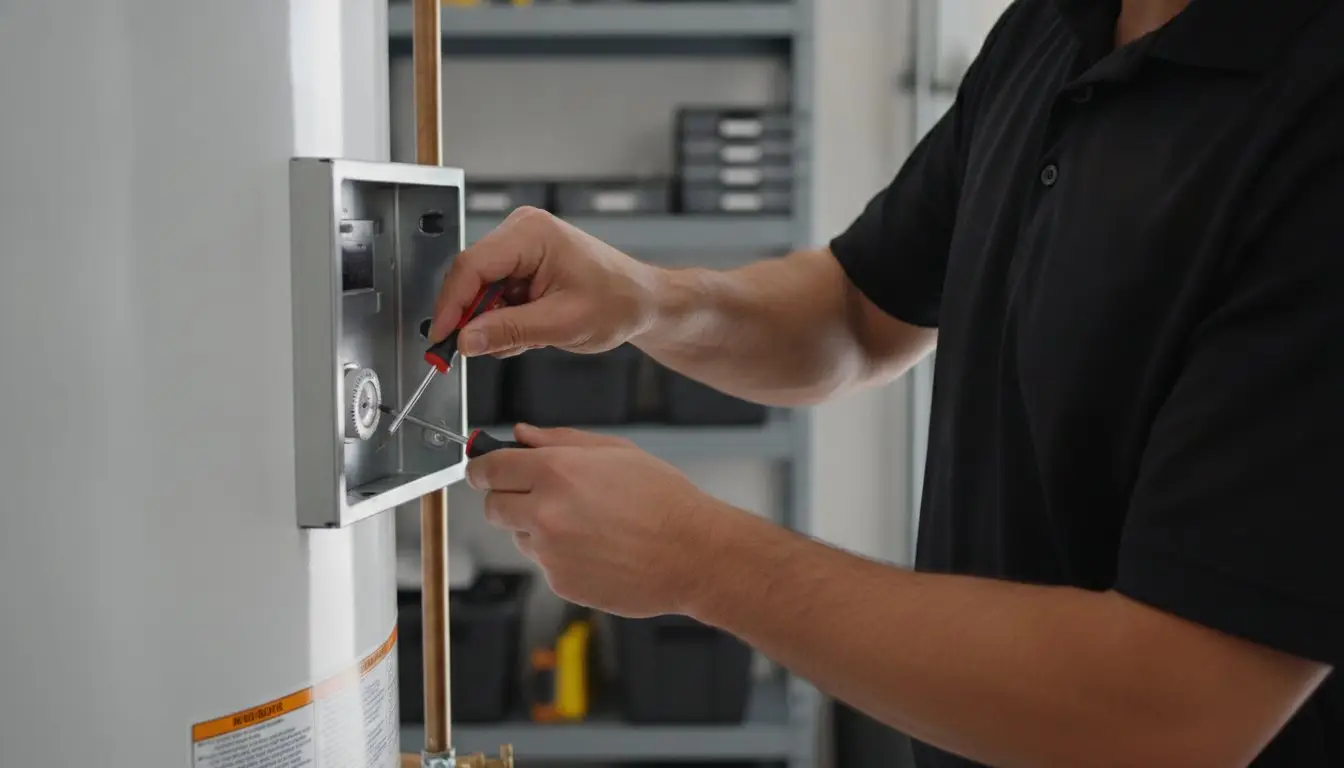
Did you know that water heating accounts for nearly 18% of your home’s total energy consumption? For many Florida homeowners, a significant portion of that monthly utility bill is literally going down the drain because the thermostat is set far higher than necessary. If you are tired of opening a $252 electric bill every month, optimizing water heater temperature for savings is one of the simplest DIY adjustments you can make to see immediate results.
We know how frustrating it is to balance rising costs with the safety of your family. No one wants to worry about scalding risks for children or elderly relatives, yet nobody wants a lukewarm shower either. In this guide, you will learn the exact temperature setting that lowers your energy usage without sacrificing your household comfort. We will walk through the 2023 Florida Building Code requirements, explain why 120 degrees is the standard recommendation, and show you how to accurately adjust your thermostat even if the markings on your older heater are confusing or faded.
Key Takeaways
- Learn how optimizing water heater temperature for savings can reduce your water heating costs by 3% to 5% for every 10-degree reduction you make.
- Understand the critical safety steps for adjusting your thermostat, including why you must disconnect power or set gas valves to ‘pilot’ before opening any access panels.
- Discover how Treasure Coast hard water creates a sediment barrier that forces your heater to work harder, regardless of your thermostat setting.
- Find out why professional tank flushing is the essential partner to temperature management for maximizing your appliance’s efficiency and lifespan.
- Explore why a tankless water heater upgrade might be the best solution for your home if you find that a safe 120°F setting doesn’t meet your family’s hot water demands.
The Science of Savings: Why 120°F Is the Magic Number
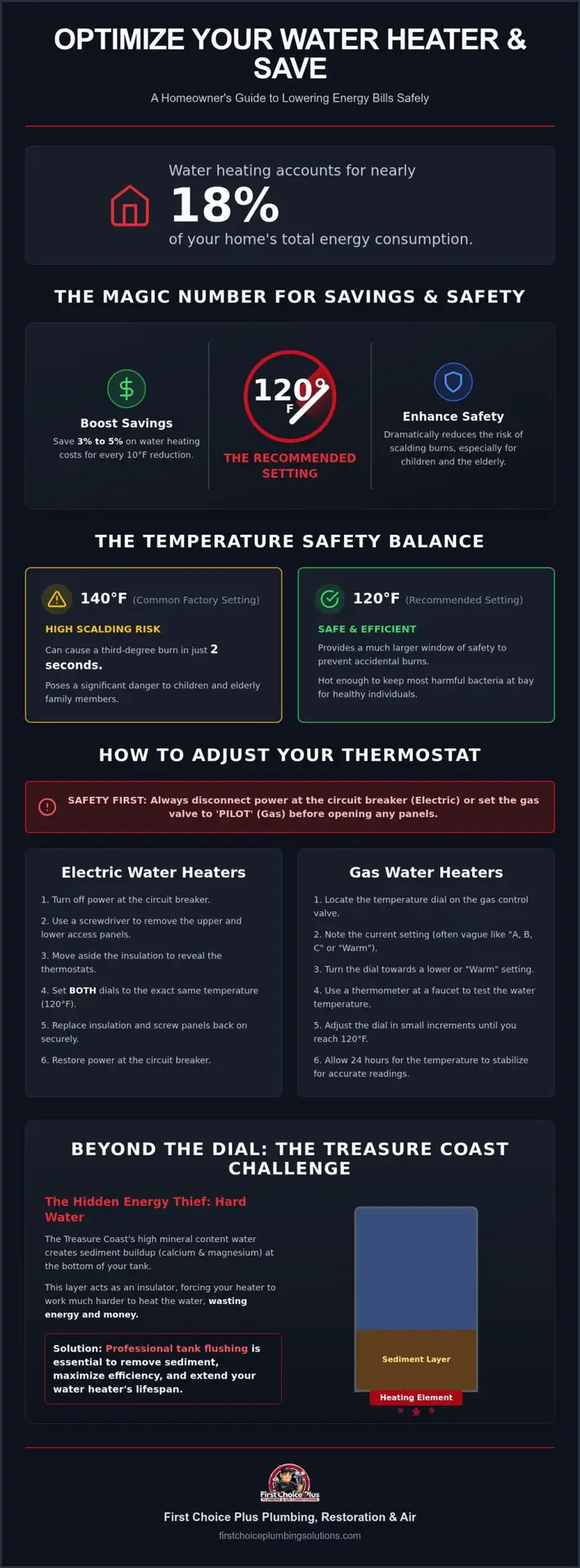
The U.S. Department of Energy and OSHA both point toward 120°F as the ideal residential setting. It isn’t an arbitrary number. This threshold provides enough heat for most household tasks while significantly reducing your energy consumption. When you focus on optimizing water heater temperature for savings, you’re tackling a major part of your monthly overhead. According to the Department of Energy, you can expect to save between 3% and 5% on your water heating costs for every 10-degree reduction you make. If you drop your setting from 140°F to 120°F, those savings quickly add up.
Living on the Treasure Coast gives us a unique advantage. Our groundwater is naturally warmer than water in northern states. This means your unit doesn’t need nearly as much energy to reach its target temperature. The Science of Water Heating shows that higher temperatures also increase standby heat loss. This is when heat escapes through the tank walls into your garage or utility closet even when you aren’t using hot water. Lowering the dial keeps more of that heat inside the water where it belongs.
The Safety Balance: Bacteria vs. Scalding
Safety is the primary reason to avoid the common factory-default setting of 140°F. At that temperature, hot water can cause a third-degree burn in just two seconds. This is a massive risk for homes with small children or elderly family members who have thinner skin. While 120°F is hot enough to keep most bacteria like Legionella at bay for healthy individuals, it provides a much larger window of safety to prevent accidental injuries.
When to Keep It Higher
Some situations require a bit more heat. If your home has immunocompromised residents or an older dishwasher without a built-in heating element, you might need to stay closer to 130°F or 140°F. In these cases, we often recommend installing mixing valves. These devices allow you to keep the water in your tank hot enough to kill all pathogens while mixing in cold water at the tap to ensure the temperature coming out of the faucet remains safe. If you’re unsure which setting is right for your home, our team can help evaluate your water heater services needs and safety requirements.
Step-by-Step: How to Adjust Your Water Heater Temperature
Adjusting your unit is a straightforward task, but safety must always come first. Before you touch any access panels, you must turn off the power at the circuit breaker for electric models or switch the gas valve to the “pilot” setting for gas units. You typically only need a flathead screwdriver and a reliable thermometer to get the job done. When you are optimizing water heater temperature for savings, precision matters more than speed. Calibration is the process of ensuring the dial setting matches the actual water output. Once you make an adjustment, wait a full 24 hours to allow the tank to stabilize before testing the water at the faucet furthest from the heater.
Adjusting Electric Water Heaters
Most electric tanks feature two heating elements, meaning you will find an upper and a lower thermostat behind separate panels. It is vital to set both to the exact same temperature to ensure the tank heats evenly and efficiently. When you finish adjusting the dials, make sure the insulation pads are tucked back into place properly. These pads are critical for preventing fire hazards and maintaining the tank’s internal heat. If you find that your dials are stuck or the access panels seem corroded, it might be time for professional plumbing repairs to ensure your system remains safe.
Adjusting Gas Water Heaters
Gas units are often easier to access because the dial is located on the exterior of the gas control valve. However, these dials often use vague markings like “A, B, C” or “Hot” and “Warm” instead of specific degrees. To get an accurate reading, run hot water at the tap and use a kitchen thermometer to find your baseline. This simple fix can help you save $36-$61 annually on your utility bills. Optimizing water heater temperature for savings is a great first step, but a well-maintained unit is what truly keeps those costs down over time.
Beyond the Dial: Maximizing Efficiency in Port St. Lucie
While turning down the thermostat is a great first step, homeowners in Port St. Lucie must deal with a hidden energy thief: hard water. The Treasure Coast is known for its high mineral content. Over time, calcium and magnesium settle at the bottom of your tank, forming a thick sediment barrier. This layer acts as an insulator between the burner and the water. Your unit ends up heating the rocks at the bottom before it can heat the water above. This is why professional flushing is a vital part of optimizing water heater temperature for savings. Without it, your heater stays on longer than necessary regardless of the dial setting.
Simple physical upgrades can also boost your efficiency. We recommend wrapping the first six feet of your hot and cold water pipes with foam insulation. This keeps the heat from dissipating as the water travels toward your faucets. If you’re tired of the constant battle with standby heat loss, a tankless system is the ultimate alternative. Because these units heat water only when you turn on a tap, they eliminate the need to keep 50 gallons of water hot all day and night.
Hard Water Solutions for the Treasure Coast
Listen to your water heater. If you hear popping, rumbling, or knocking sounds, that is the sound of sediment trapping steam at the bottom of the tank. These minerals don’t just waste energy; they can eventually cause the tank to overheat and fail. Installing water quality solutions like a whole-home water softener can stop this scale from building up. It protects your plumbing and ensures your heater doesn’t have to work overtime to provide a hot shower.
When to Call a Professional
Some problems cannot be solved by a simple adjustment. If your water temperature fluctuates wildly even after you’ve tried optimizing water heater temperature for savings, you might have a failing heating element or a broken dip tube. You should also pay attention to your anode rod. This is an affordable part designed to corrode so your expensive tank doesn’t have to. If you haven’t had your rod inspected in over three years, it is time to schedule water heater services. A small investment in maintenance today prevents a flooded garage tomorrow.
Take Control of Your Home’s Energy Efficiency
Finding the right balance for your water heater doesn’t have to be a guessing game. By optimizing water heater temperature for savings and maintaining a steady 120°F setting, you can protect your family from scalding while keeping your utility bills under control. Remember that a simple dial adjustment works best when paired with a clean, sediment-free tank. Our expert plumbers have been serving Port St. Lucie and the Treasure Coast since 2007, providing the technical authority and neighborly care your home deserves.
We know that Florida’s hard water presents unique challenges for local plumbing systems. Whether you need help calibrating your thermostats or require 24/7 emergency support for a sudden leak, we’re here to provide a steady hand. Don’t let sediment buildup or an inefficient setting steal your hard-earned savings. Schedule your professional water heater flush and efficiency check today! We look forward to helping you enjoy reliable hot water and lower energy costs for years to come.
Frequently Asked Questions
Will lowering my water heater temperature to 120°F make me run out of hot water faster?
Yes, you may notice that your hot water supply feels slightly smaller because you aren’t mixing in as much cold water at the showerhead. When your tank is set to a very high temperature, you only need a small amount of hot water to achieve a comfortable temperature. At 120°F, you use a higher volume of the water stored in the tank. If your family regularly runs out of hot water at this setting, it often points to a heavy sediment layer or an undersized tank.
How much money can I actually save by turning down my water heater?
Homeowners can typically reduce their water heating costs by a range of 4% to 22% by lowering the temperature from 140°F to 120°F. This is a primary strategy when optimizing water heater temperature for savings because it requires no financial investment. While the exact dollar amount depends on your household’s specific usage patterns, this adjustment consistently lowers the energy required for both standby heating and active water use. It provides immediate relief on your monthly utility statement.
Is it safe to set my water heater to 120°F if I have a dishwasher?
It is safe for the vast majority of homes because most dishwashers built in the last decade include an internal booster heater. This feature automatically increases the incoming water to the 140°F required for effective cleaning and sanitation. If you own an older model without a booster, you may need to keep your tank at a higher setting to ensure your dishes are properly sanitized. Check your dishwasher’s user manual to confirm if it’s compatible with a 120°F supply.
What do the letters A, B, and C mean on my gas water heater dial?
These letters represent specific heat ranges where the “Hot” setting typically aligns with 120°F. On most standard gas control valves, each subsequent letter represents a 10-degree increase. For example, “A” is usually 130°F, “B” is 140°F, and “C” is 150°F. Since these dials can lose accuracy over time, we suggest using a kitchen thermometer at the nearest faucet to confirm the actual temperature. This ensures your home remains within a safe and efficient range.

Article by
Written by First Choice Plus Plumbing & Air Team
This article was created by the team at First Choice Plumbing Solutions, a licensed and experienced plumbing and HVAC company serving Port St. Lucie, Land O’ Lakes, and surrounding areas.
Our team specializes in plumbing and air conditioning services, including drain cleaning, leak detection, water heater repair and installation, AC repair, maintenance, and system installations. Our content is based on real-world experience and the common issues we solve for homeowners and businesses every day.
We aim to provide accurate, helpful, and easy-to-understand information so you can make informed decisions about your plumbing and HVAC needs.
If you need reliable, professional service, First Choice Plumbing Solutions is here to help.
Disclaimer
Disclaimer: The information provided in this article is for general informational purposes only and does not constitute professional plumbing or HVAC advice. Every situation is different, and readers should consult a licensed professional for proper diagnosis and repair. First Choice Plus Plumbing & Air is not liable for any damages or losses resulting from the use of this information.