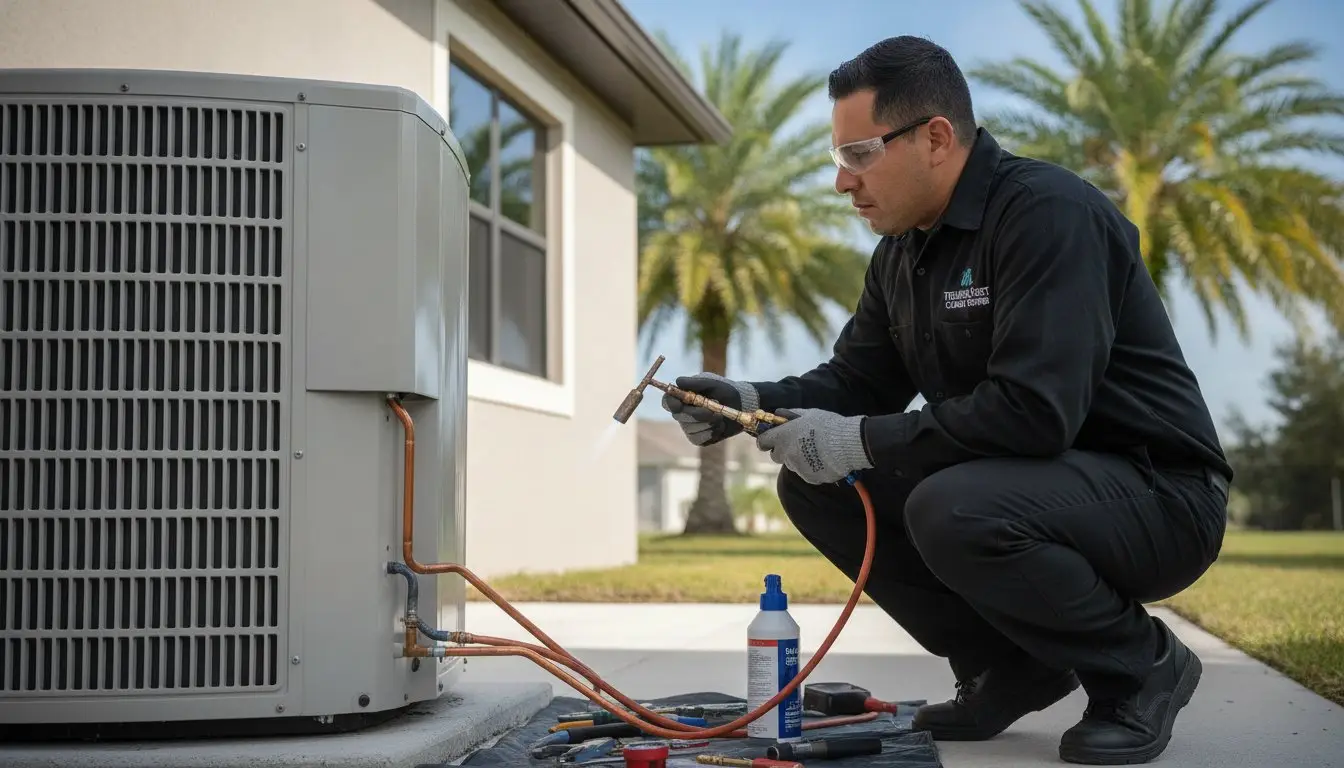
Did you know that nearly 90% of U.S. households rely on air conditioning, yet a poor installation can instantly slash your new system’s efficiency by 25%? Living here in the Treasure Coast, you already know that a failing unit isn’t just an inconvenience. It’s a household emergency that invites sweltering heat and invasive humidity into your sanctuary. To protect your investment, you need a professional new air conditioner installation checklist for homeowners that accounts for local building codes and our extreme tropical environment.
Replacing your unit in 2026 means navigating more than just a simple box swap. With federal tax credits for HVAC having expired at the end of 2025 and new A2L refrigerants like R-454B becoming the industry standard, the stakes for getting it right have never been higher. This guide provides a clear roadmap to mastering your AC replacement. We’ll cover everything from 15.2 SEER2 efficiency minimums to the humidity control secrets that prevent mold growth. You will gain the peace of mind that your home will stay cool, dry, and affordable for years to come.
Key Takeaways
- Learn why a Manual J load calculation is the only way to ensure your unit handles the Florida sun without driving up energy bills.
- Use our new air conditioner installation checklist for homeowners to verify your technician properly vacuums refrigerant lines to prevent long-term damage.
- Stay compliant with 2026 Florida regulations, including the minimum 15.2 SEER2 rating and the shift to new eco-friendly refrigerants.
- Discover how proper system calibration and UV air sanitizers can protect your home from Florida’s chronic humidity and mold risks.
- Ensure your investment is protected by confirming that all necessary local building permits and final inspections are completed.
Pre-Installation: Selecting the Right System for the Florida Climate
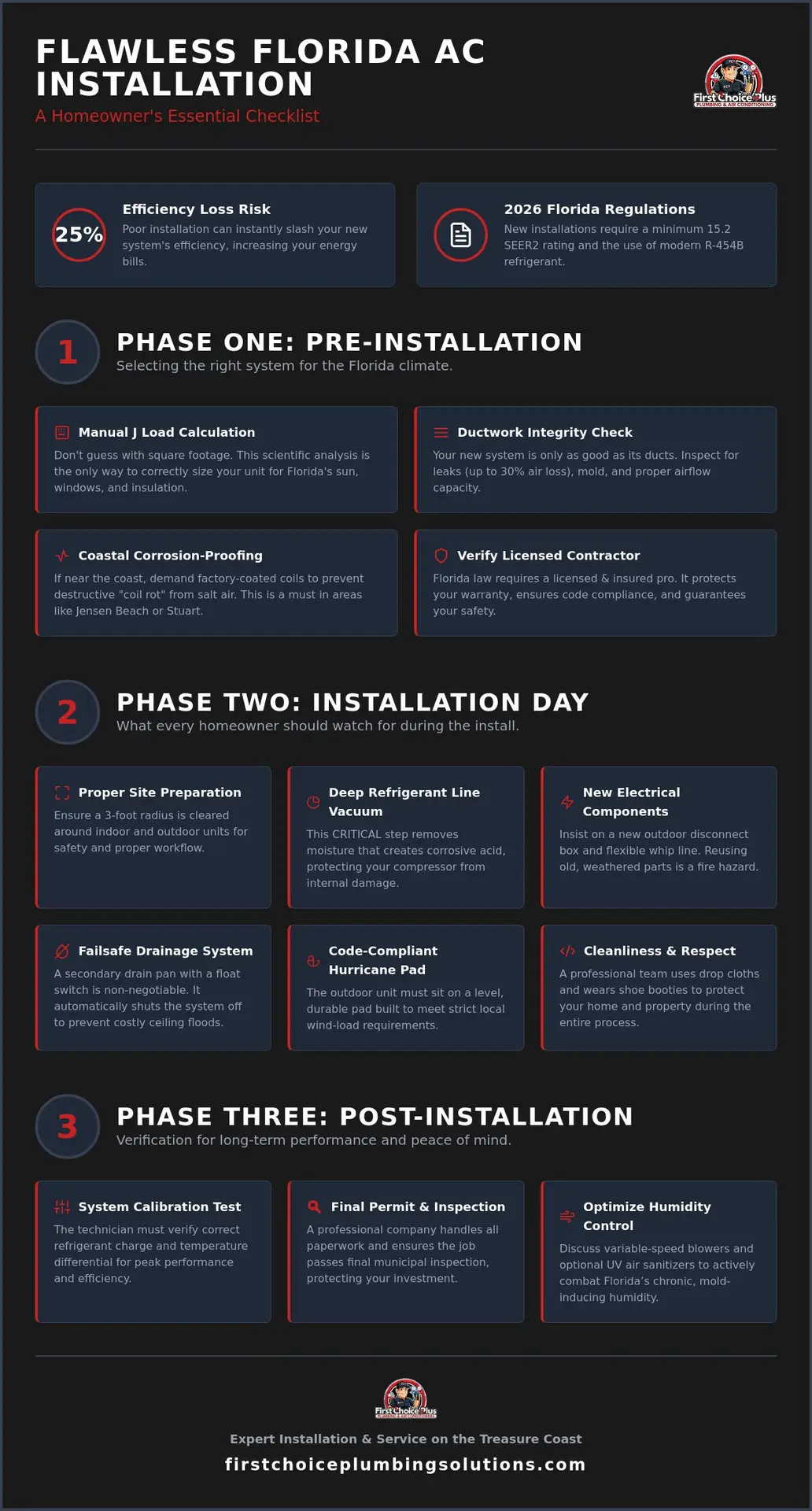
Before you sign a contract or put down a deposit, your new air conditioner installation checklist for homeowners must start with a Manual J Load Calculation. Don’t let a contractor guess your system size based on square footage alone. This technical assessment accounts for your roof’s orientation to the Florida sun, the number of windows in your home, and your current insulation levels. An oversized unit will short-cycle, leaving your home damp and humid, while an undersized unit will run constantly, leading to a premature breakdown and sky-high utility bills.
Efficiency standards have also shifted. As of 2026, all new split-system central air conditioners installed in Florida must meet a minimum efficiency rating of 15.2 SEER2. While this is the legal baseline, many Treasure Coast homeowners opt for higher ratings to combat our year-round cooling demands. You should also verify that the system uses the latest R-454B refrigerant. As of January 2025, manufacturers stopped producing new units with R-410A, so choosing the modern standard ensures your system remains serviceable and eco-friendly for its entire lifespan.
If your home is located in coastal areas like Jensen Beach or Stuart, salt air is a silent killer for HVAC equipment. Ask your contractor about units with factory-applied, corrosion-resistant coatings on the condenser coils. Without this protection, salt-air “coil rot” can destroy your system’s efficiency in just a few years. To maximize comfort, prioritize systems with variable-speed blowers. These modern Air conditioning components are designed to run at lower speeds for longer periods, which is significantly more effective at pulling moisture out of the air than older, single-speed models.
Evaluating Your Existing Ductwork and Ventilation
Your new high-efficiency unit is only as good as the ductwork it’s connected to. We often find that older ducts are either too small for modern air handlers or riddled with leaks that waste up to 30% of your cooled air. Before the new system arrives, have your technician inspect for mold growth and verify that your registers can handle the increased airflow. It’s also the perfect time to check your attic’s insulation; if your R-value is too low, your new AC will work twice as hard to maintain a comfortable temperature.
Choosing a Licensed Treasure Coast Contractor
Florida law requires HVAC installations to be performed by a licensed and insured contractor. This isn’t just about legality; it’s about your safety and warranty protection. Ask for local references in Port St. Lucie or Fort Pierce to ensure the company has a track record of reliability in our specific climate. A professional team will always provide a transparent cost structure and treat your home with respect by using floor protection and shoe booties. For more localized advice on maintaining your comfort, check out our HVAC Port St. Lucie Guide to see how we help your neighbors stay cool.
Installation Day Checklist: What Homeowners Should Watch For
Installation day is when the technical heavy lifting happens. Your new air conditioner installation checklist for homeowners should begin with proper site access. Before the crew arrives, clear a 3-foot radius around the outdoor pad and the indoor air handler. Move any patio furniture, potted plants, or stored items. Secure your pets in a quiet room to prevent stress and keep them away from open doors while technicians move equipment in and out of your home.
Watch for the vacuum pump during the setup process. A professional installer will use one to pull a deep vacuum on the refrigerant lines. This step removes non-condensables and moisture from the system. If moisture remains inside the lines, it creates acid that eats your compressor from the inside out. Don’t be afraid to ask your lead technician if the lines have reached the required micron level before they charge the system with refrigerant.
Electrical components and drainage are equally vital for a long-lasting install. Ensure the team installs a new outdoor disconnect box and flexible whip line. Using old, weathered electrical parts on a brand-new system is a fire risk and often violates current Florida building codes. For drainage, verify that a secondary drain pan is placed under the indoor unit. A float switch is also essential; it automatically shuts down the system if the drain line clogs, preventing a costly ceiling flood.
Protecting Your Property During the Install
Professional teams prioritize cleanliness and respect for your home. They should use drop cloths and wear shoe booties whenever they enter your living spaces. Outside, the new condenser must sit on a level, code-compliant hurricane pad. These pads are heavier and more durable than standard ones to meet strict local wind-load requirements. Finally, confirm that the old equipment and all installation debris will be hauled away as part of your service agreement.
Indoor Air Quality and Filtration Setup
Since the system is already open, it’s the most cost-effective time to install UV air sanitizers. These lights neutralize mold spores and bacteria before they circulate through your home. Check that the filter rack is positioned for easy access. You’ll need to change your filters monthly to maintain peak efficiency. If you need help choosing the right filtration level for your family’s health, the experts at First Choice Plus Plumbing & Air can guide you through the best options for your specific model.
Post-Installation Verification and Long-Term Performance
Once the technicians pack their tools, the final phase of your new air conditioner installation checklist for homeowners begins. The work isn’t truly finished until you’ve verified the system’s performance and secured your legal protections. In the Treasure Coast, local building departments in Port St. Lucie and Stuart require a final inspection to close out your permit. This step is non-negotiable; it’s your third-party verification that the electrical work and hurricane strapping meet the latest Florida Building Code standards.
Confirm with your contractor that they have officially registered your unit with the manufacturer. Most brands offer a 5-year parts warranty by default, but this is usually doubled to 10 years if the system is registered within 60 days of installation. Keep a physical or digital copy of this confirmation for your records. To keep that warranty valid and combat the relentless Florida heat, schedule your first bi-annual tune-up for six months from today. Professional maintenance and repair services—similar to the expert care provided by Christensen Heating and Cooling—are the only way to ensure your high-efficiency system actually delivers the lower utility bills you were promised.
Testing the System Performance
Walk through the home with the lead technician to test the “temperature split.” Use a digital thermometer to verify that the air exiting the supply vents is 15 to 20 degrees cooler than the air entering the return vent. Listen closely as the system cycles. You should hear a steady, quiet hum rather than any whistling, rattling, or grinding. Finally, have the tech walk you through your new smart thermostat’s features, especially the humidity sensing and “away” modes that maximize your energy savings.
Local Treasure Coast Rebates and Financing
Take advantage of every available dollar to offset your investment. Florida Power & Light (FPL) currently offers a $200 instant rebate for qualifying high-efficiency systems. While federal tax credits for HVAC expired at the end of 2025, local utility programs still provide significant incentives for homeowners who prioritize SEER2 compliance. If the upfront cost of a premium system is a concern, we offer flexible financing options to help you secure a reliable cooling system without draining your savings. These plans allow you to pay for your comfort over time while you immediately benefit from lower monthly power bills.
Secure Your Home’s Comfort for the Decade Ahead
Investing in a high-efficiency cooling system is one of the most significant decisions you’ll make for your Florida home. By following this new air conditioner installation checklist for homeowners, you’ve learned how to verify proper system sizing, ensure 2026 SEER2 compliance, and protect your property during the physical installation. These steps don’t just lower your monthly utility bills; they provide the peace of mind that your family will stay cool and dry even during our most humid Treasure Coast summers.
At First Choice Plus Plumbing & Air, we pride ourselves on being the steady hand you can trust for complex home upgrades. As licensed and insured HVAC experts, we provide transparent pricing with no hidden fees and 24/7 emergency support for homeowners across Port St. Lucie, Stuart, and Fort Pierce. We treat your home with the respect it deserves, from using shoe booties to ensuring every permit is closed out correctly. Don’t leave your comfort to chance with a subpar installation. Schedule Your Professional AC Installation Quote Today and take the first step toward a more efficient, reliable home. We look forward to serving as your trusted local experts.
Frequently Asked Questions
How long does a typical new AC installation take in Florida?
A standard air conditioner replacement usually takes between four to eight hours to complete. If your project requires extensive ductwork repairs or moving the air handler to a new location, the process might extend into a second day. Our goal is always to restore your cooling as quickly as possible without skipping any technical steps on your new air conditioner installation checklist for homeowners.
Should I replace my indoor and outdoor units at the same time?
Yes, you should always replace the indoor air handler and the outdoor condenser as a matched set. Modern 15.2 SEER2 systems are designed to work together; mixing a new outdoor unit with an old indoor coil will significantly reduce efficiency and often voids the manufacturer’s warranty. Installing a matched system ensures that all components use the same refrigerant and communication protocols for peak performance.
What is the most efficient AC unit for the Port St. Lucie humidity?
Variable-speed systems are the most effective choice for managing the intense humidity we face in Port St. Lucie. Unlike traditional units that only turn on or off, variable-speed models adjust their output to run for longer periods at lower speeds. This allows the system to pull significantly more moisture out of the air. Expert providers like E.R.S. Heating & Cooling often recommend these high-performance options for their superior comfort and efficiency. When paired with UV air sanitizers, these units provide the best indoor air quality and comfort.
Do I need a permit for a new air conditioner in Stuart or Fort Pierce?
Florida law requires a building permit for every central AC installation in Stuart, Fort Pierce, and surrounding areas. This requirement isn’t just a formality; it triggers a mandatory safety inspection by the local building department. The inspector verifies that the electrical connections are safe and that the outdoor unit is properly secured to withstand hurricane-force winds. We handle the entire permitting process to ensure your home remains fully compliant with state codes.
Article by
Written by First Choice Plus Plumbing & Air Team
This article was created by the team at First Choice Plumbing Solutions, a licensed and experienced plumbing and HVAC company serving Port St. Lucie, Land O’ Lakes, and surrounding areas.
Our team specializes in plumbing and air conditioning services, including drain cleaning, leak detection, water heater repair and installation, AC repair, maintenance, and system installations. Our content is based on real-world experience and the common issues we solve for homeowners and businesses every day.
We aim to provide accurate, helpful, and easy-to-understand information so you can make informed decisions about your plumbing and HVAC needs.
If you need reliable, professional service, First Choice Plumbing Solutions is here to help.
Disclaimer
Disclaimer: The information provided in this article is for general informational purposes only and does not constitute professional plumbing or HVAC advice. Every situation is different, and readers should consult a licensed professional for proper diagnosis and repair. First Choice Plus Plumbing & Air is not liable for any damages or losses resulting from the use of this information.