
Table of Contents
- What Affects Natural Gas Line Installation Cost
- Average Cost Per Foot for Gas Line Installation
- Labor vs. Material Costs Breakdown
- Gas Line Installation Permit Requirements and Inspection Fees
- DIY vs. Professional Gas Line Installation
- Cost to Run Gas Line to Outdoor Grill and Appliances
- Utility Company vs. Private Contractor Roles
- Post-Installation Testing and Hidden Retrofit Costs
Last Updated: August 4, 2026
What Affects Natural Gas Line Installation Cost
Natural gas line installation cost depends on several interconnected factors: property conditions, material choices, and regulatory requirements. The price varies far less on a simple per-foot rate and far more on specific site circumstances. A 50-foot line through open basement space costs nothing like a 50-foot line requiring trenching under concrete and navigating buried utilities, this distinction often accounts for 40-60% of total cost variation.
Project Complexity and Site Conditions
Project complexity separates routine work from installations demanding specialized expertise. A simple indoor run from meter to appliance represents baseline work; everything else adds difficulty and cost.
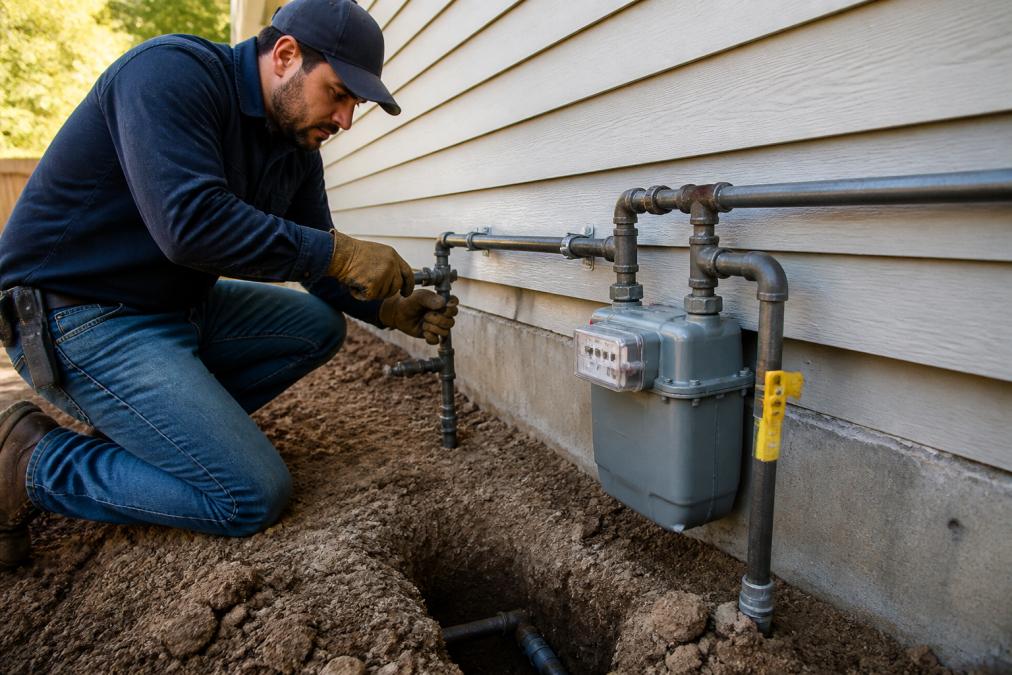
Trenching requirements multiply expenses rapidly. Running a line to an outdoor grill means digging below frost line depth, typically 24-36 inches in most U.S. climates. Crossing a driveway requires concrete cutting, asphalt excavation, and restoration. Rocky soil, tree roots, or existing utility lines trigger additional labor and equipment rental.
Site access matters enormously. Finished basements require careful routing through walls, often necessitating multiple openings. Crawl spaces offer easier access but may require additional support structures. Older homes present unique challenges: pre-existing plumbing may occupy logical routing paths, and foundation settling complicates underground runs. Retrofit complications routinely add 20-35% to estimated costs.
Material Types: Black Iron Pipe vs. CSST
Black iron pipe requires threaded connections at every joint, demanding more labor and fittings. Installation labor typically runs 15-25% higher than CSST, though the material itself costs less. Black iron lasts 50+ years when properly maintained.
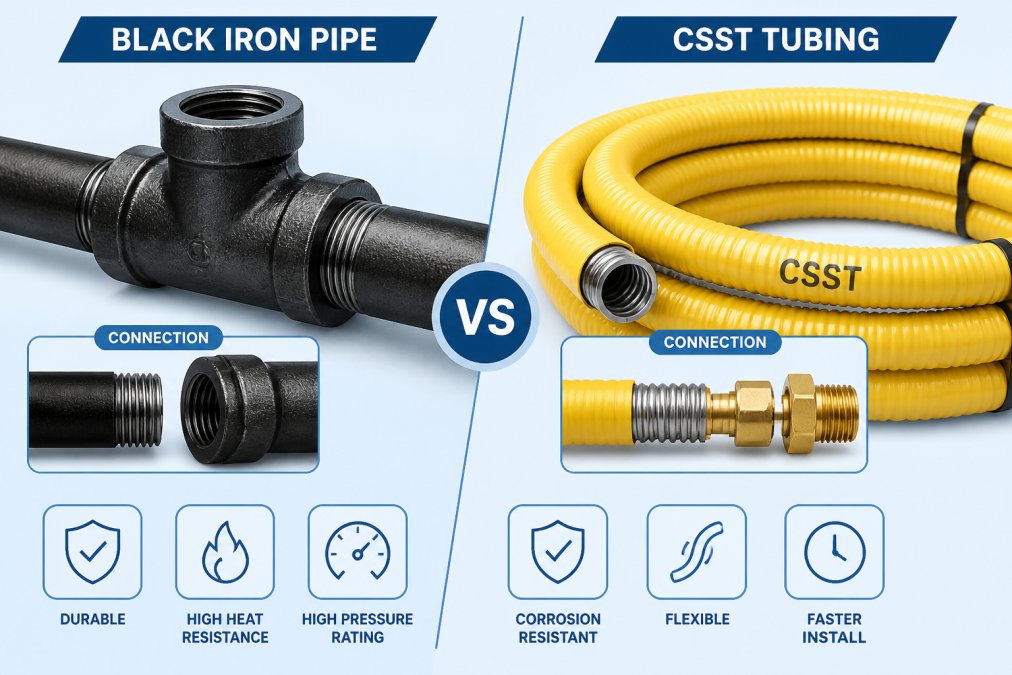
CSST (Corrugated Stainless Steel Tubing) installs faster due to flexibility, reducing labor time by 20-30%. However, CSST costs more per linear foot, and some municipalities restrict its use or require additional bonding. Check local codes before assuming CSST is an option.
Hybrid approaches using CSST for flexible runs and black iron for main trunk lines optimize cost and compliance.
Linear Footage and Trenching Requirements
Distance establishes the baseline but doesn’t determine cost alone. A 20-foot indoor run costs significantly less than a 100-foot run, but doubling distance doesn’t double cost because fixed setup labor remains constant.
Trenching transforms the equation. Shallow trenches (18-24 inches) cost roughly $5-15 per linear foot in soft soil. Frost-line trenches (24-36 inches) in harder soil run $15-30 per linear foot. A 50-foot trench under a driveway easily costs $1,500-2,500 for excavation and restoration.
Sand bedding beneath the pipe (standard practice) costs $2-5 per linear foot. Frost line depths vary dramatically by climate: Florida requires minimal depth, while northern states demand 36-48 inches. This single factor can increase trenching costs by 50-100% for northern installations.
Average Cost Per Foot for Gas Line Installation
Indoor installations typically run $15-30 per linear foot for labor and materials combined. Outdoor runs with trenching run $25-50 per linear foot depending on soil conditions and depth. A 30-foot indoor run might cost $450-900; the same distance outdoors with trenching could cost $750-1,500.
Add permits (typically $100-300), inspection fees, and appliance connections, and total project cost increases by 20-30%. The per-foot metric breaks down for short runs: a 10-foot line costs nearly as much as a 20-foot line because setup and site preparation dominate labor.
Material costs represent 20-35% of the total. Black iron pipe runs roughly $0.50-1.50 per linear foot, while CSST costs $1.50-3.00 per linear foot. Fittings, valves, and connectors add another $100-300.
Labor vs. Material Costs Breakdown
Labor accounts for 65-75% of total cost, while materials represent 25-35%. Gas line work demands licensed professionals; hourly rates typically range $75-150 per hour, though many contractors charge flat rates.
A straightforward 40-foot indoor run might take 4-6 hours of labor at $100 per hour average, totaling $400-600. The same project with trenching and obstacles could consume 12-16 hours, pushing labor costs to $1,200-1,600.
Material selection offers limited cost-saving opportunity without sacrificing quality or code compliance. The real cost control lever is project simplicity: work with your contractor to identify straightforward routing that meets code, minimize trenching depth, and plan the route before work begins.
Gas Line Installation Permit Requirements and Inspection Fees
Permits ensure work meets current code and protect both you and future property owners. Skipping permits creates liability, voids insurance coverage, and complicates home sales.
When You Need a Permit
Nearly every jurisdiction requires a permit for new gas line installation. Exceptions are rare and typically limited to replacing existing lines with identical materials and routing. Adding a new appliance connection, extending a line, or upgrading a meter almost always requires a permit.
Permit applications require drawings or descriptions of proposed work, including routing, materials, and pressure testing plans. Most jurisdictions process applications within 1-2 weeks. Permit costs typically range from $75-200 depending on location and project scope. Some jurisdictions charge based on appliance connections rather than linear footage.
Building Inspector and Code Compliance
The building inspector verifies installation meets code before and after the line is buried or concealed. Most jurisdictions require two inspections: rough inspection before covering, and final inspection after pressure testing and appliance connections.
Inspection fees typically run $50-150 per inspection, though some jurisdictions bundle this into the permit fee. The inspector checks pipe sizing, support and hangers every 4-6 feet, proper slope for condensate drainage, clearance from electrical wiring, and correct pressure test procedures.
The National Fuel Gas Code establishes baseline standards, but individual states and municipalities often impose stricter requirements. Your contractor must know and follow your specific local code.
DIY vs. Professional Gas Line Installation
Most states prohibit unlicensed individuals from installing gas lines. This reflects genuine hazard: improper installation creates explosion risk that can destroy your home and injure occupants.
Safety Considerations and Regulations
Proper installation requires understanding gas pressure, pipe sizing based on appliance demand, slope requirements for condensate drainage, and pressure testing procedures. A line appearing to work initially can develop leaks months later if connections weren’t sealed correctly.
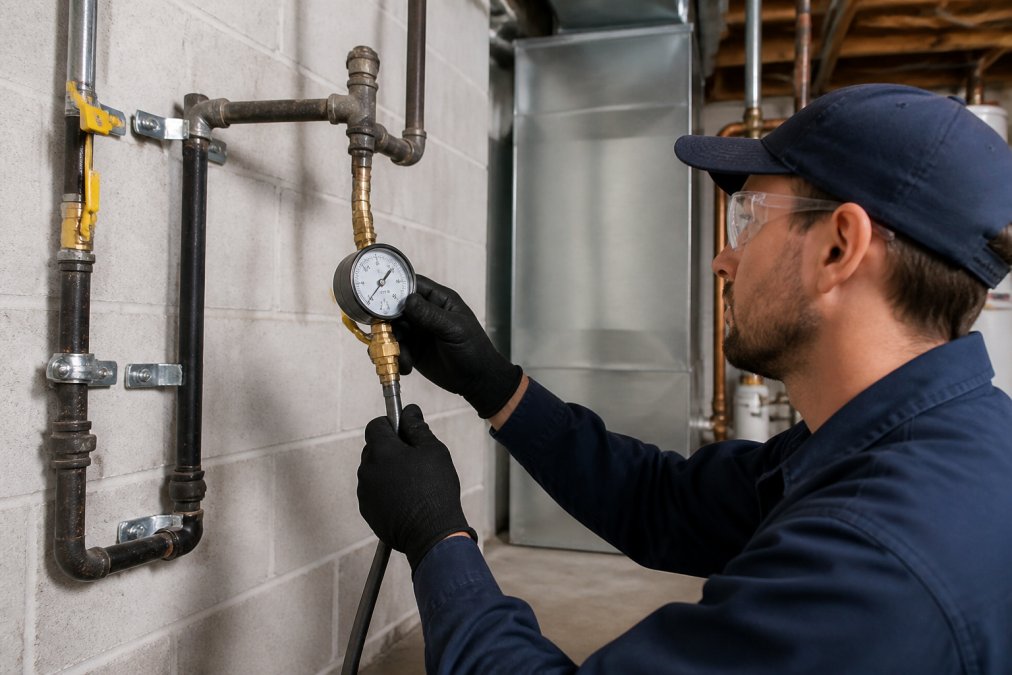
Pressure testing demands specialized equipment. Professional pressure testing uses nitrogen and specialized gauges to verify the system holds pressure without leaking.
Liability and Insurance
Installing a gas line yourself voids homeowner’s insurance coverage for resulting damage. If a leak causes explosion, injury, or death, your insurance won’t cover it, and you’ll face personal liability.
Permit inspectors won’t approve DIY installation in most jurisdictions. Selling your home with unpermitted gas line work creates major complications; home inspectors flag unpermitted work, and many buyers won’t proceed without remediation.
Cost to Run Gas Line to Outdoor Grill and Appliances
Outdoor gas lines must withstand weather, temperature fluctuations, and UV exposure. A line to an outdoor grill typically costs more than equivalent indoor installation due to trenching and weatherproofing.
A 20-foot run with 24-inch trenching might cost $400-700 for materials and labor. Add sand bedding, proper slope, and weatherproof connections, and you’re looking at $500-900 for the line itself. Pressure testing and inspection add $150-300. A complete outdoor grill installation typically runs $700-1,200.
Winterization matters in cold climates. Outdoor lines must slope for condensate drainage and may require insulation or heat tracing in severe winters, costing $100-300 but preventing freeze damage.
Utility Company vs. Private Contractor Roles
Understanding distinct responsibilities prevents confusion and cost overruns.
Service Line Installation by the Utility
The utility company owns and maintains the gas main in the street and the service line from main to meter. If you need a new service line installed or upgraded, the utility typically handles this work.
Utility service line installation costs vary by region. Some utilities charge a flat fee ($300-500), while others base charges on distance or complexity. Contact your utility company to request installation; this typically takes 2-4 weeks.
In-Home Installation by a Licensed Plumber
Everything from the meter forward into your home and to appliances is your responsibility. You hire a licensed plumber or gas fitter for routing, connections, testing, permits, and inspections.
Licensed contractors carry liability insurance, understand local code, and obtain permits and inspections. They provide warranties on work, typically 1-2 years for labor.
At First Choice Plus Plumbing & Air, we handle full in-home installation from design through final inspection and appliance connection. We coordinate with utility companies on meter location but manage work critical to your home’s safety and functionality.
Choose contractors based on more than price. Verify licensing, check references, confirm insurance, and get detailed written estimates before committing.
Post-Installation Testing and Hidden Retrofit Costs
Installation completion requires proper testing and inspection to ensure safe operation.
Pressure Testing and Leak Detection
Pressure testing verifies the system holds pressure without leaking. Contractors fill the line with nitrogen and monitor pressure over time. Leak detection follows, applying soapy water to connections and looking for bubbles indicating escaping gas.
Pressure testing and leak detection typically cost $100-200. If leaks are found and require repair, additional labor costs apply, usually $50-150 per leak.
Hidden Costs of Retrofitting Older Homes
Retrofitting older homes often reveals unexpected issues increasing costs beyond initial estimates. Outdated plumbing or electrical work may occupy logical routing paths. Older homes often lack proper grounding or bonding, which modern code requires, adding $200-400.
Asbestos or lead paint complicates wall penetrations, requiring containment and disposal protocols, adding $300-500. Settling foundations create routing challenges requiring more creative routing and connections.
Budget 15-25% above estimated cost for retrofit projects in homes older than 40 years to account for unknowns that surface once work begins.
Natural gas line installation is a significant investment in your home’s functionality and safety. Cost varies dramatically based on distance, trenching requirements, material choices, and local code demands. Focus on finding a licensed, experienced contractor who understands your local requirements and delivers code-compliant work with proper testing and inspection.
First Choice Plus Plumbing & Air brings 24/7 availability, transparent upfront pricing, and honest recommendations to every gas line project. We handle the full scope from design through final inspection and coordinate with utility companies for seamless integration. Call us today for a consultation on your gas line installation needs.
Frequently Asked Questions
How much does natural gas line installation typically cost?
Natural gas line installation costs depend on project complexity, linear footage, material type, permits, and site conditions. Pricing varies significantly based on whether you're running a new service line from the utility meter or installing branch lines to appliances. For an accurate estimate tailored to your specific project, First Choice Plus Plumbing & Air provides upfront pricing and free consultations. Contact us for a detailed quote based on your home's layout and needs.
What's the average cost per foot for gas line installation?
Per-foot costs vary widely based on material choice, terrain, and labor rates in your area. Black iron pipe typically costs less per foot than CSST, but installation complexity affects total labor time. Trenching requirements, whether the line runs through conduit, and accessibility all impact the final per-foot cost. Rather than relying on generic per-foot estimates, it's best to have a licensed professional assess your specific project. First Choice Plus provides transparent pricing breakdowns so you understand exactly what you're paying for.
Do I need a permit to install a new gas line?
Yes, most jurisdictions in Florida require permits for new natural gas line installations. Permits ensure the work meets current building codes and safety standards set by your local authority having jurisdiction. Your plumber should handle the permit application and coordinate with the building inspector for the pressure test and final inspection. Skipping permits can create problems when selling your home and leaves you liable if something goes wrong. First Choice Plus handles all permit requirements and inspections as part of our service.
Can I install a natural gas line myself, or do I need a professional?
Natural gas line installation should only be performed by a licensed professional. Gas work carries serious safety risks including explosions, carbon monoxide poisoning, and property damage if done incorrectly. Florida requires licensed plumbers to perform gas piping work to ensure code compliance and proper pressure testing. Attempting DIY installation voids manufacturer warranties, violates building codes, and may cause your insurance to deny claims. Professional installation protects your family and your investment.
This article was written using GrandRanker