What if a simple pipe repair turned into a legal nightmare because a worker tripped in your kitchen and lacked the right coverage? For many homeowners in Port St. Lucie and the Treasure Coast, the biggest worry isn’t just the leak; it’s the liability. You might find yourself asking, “is my plumber insured and bonded check Florida,” only to get lost in a sea of confusing state websites and technical jargon. It’s completely normal to feel anxious about hiring someone who might disappear or, worse, perform unlicensed work that voids your own home insurance policy.
We believe you deserve total peace of mind when a technician enters your home. This guide will teach you exactly how to verify a Florida plumber’s license, insurance, and bonding status in about five minutes. You’ll learn the critical difference between “Certified” and “Registered” contractors and how to use the DBPR portal like a pro. We’re breaking down the 2026 requirements so you can hire with confidence, knowing your property in Stuart, Fort Pierce, or Jensen Beach is fully protected by a legitimate local expert who respects your time and your safety.
Key Takeaways
- Understand the critical difference between Certified and Registered licenses to ensure your plumber is legally authorized to work in your Treasure Coast neighborhood.
- Learn how to use the DBPR portal to verify a contractor’s active status and check for any history of public complaints or disciplinary actions.
- Discover why asking “is my plumber insured and bonded check Florida” is the essential first step to shielding yourself from liability if a worker is injured on your property.
- See how hiring licensed professionals for complex repairs prevents your homeowner’s insurance from denying coverage for future water damage claims.
- Follow our 5-minute verification checklist to confirm your plumber meets the 2026 Florida requirements for general liability and workers’ compensation.
The Homeowner’s Checklist: Understanding Florida Plumbing Licenses and Insurance
Hiring a plumber in Florida isn’t just about finding someone who knows how to fix a leak. It’s about ensuring you have a legal shield between your bank account and a potential disaster. To properly verify “is my plumber insured and bonded check Florida,” you must understand the specific standards the state sets for your protection. These requirements aren’t just red tape; they’re designed to keep homeowners from bearing the cost of professional errors.
Florida-Specific License Types You’ll Encounter
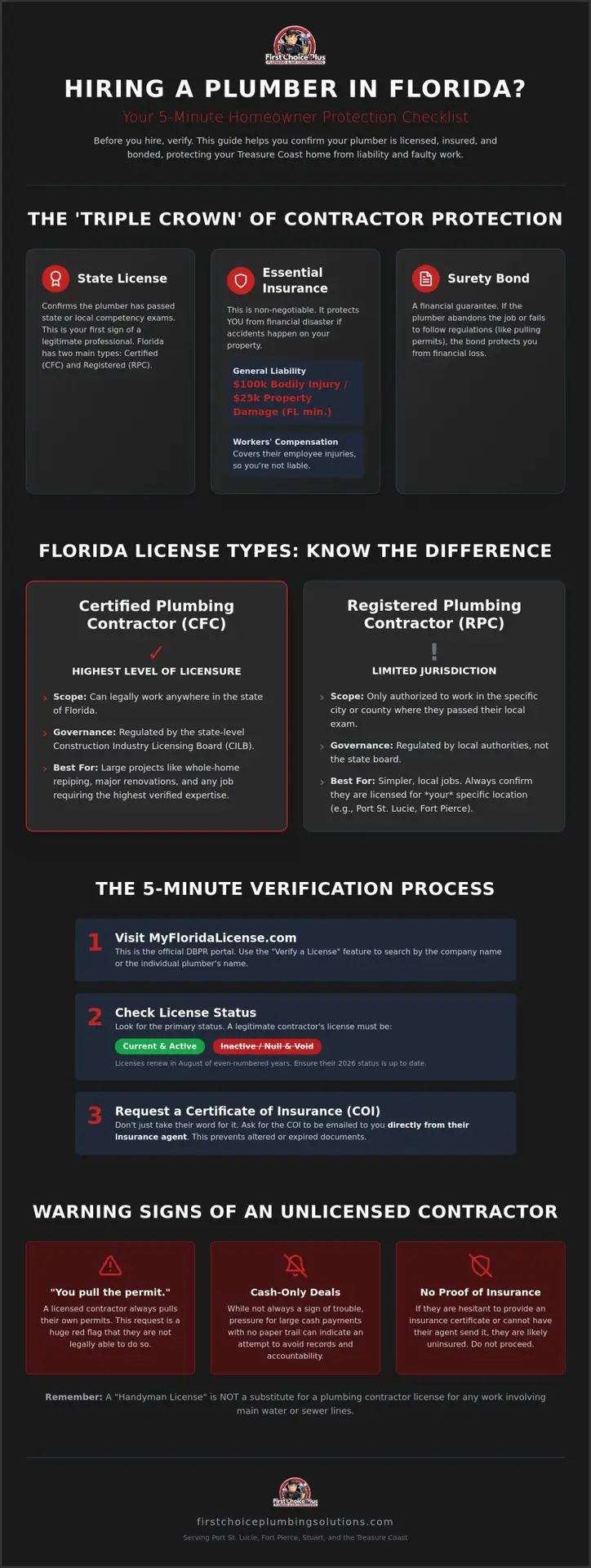
Florida categorizes plumbers into two main groups. A Certified Plumbing Contractor (CFC) has passed a rigorous state-level exam and can operate anywhere in the state. They are governed by the Construction Industry Licensing Board (CILB). In contrast, a Registered Plumbing Contractor (RPC) is only authorized to work in the specific local jurisdiction where they passed their competency exam. For high-stakes jobs like a whole house repiping, a state-certified plumber offers a higher level of verified expertise. This distinction is vital for homeowners in areas like Fort Pierce and Stuart who want to ensure their contractor isn’t working outside their legal boundary.
The Essential ‘Triple Crown’ of Protection
Total security requires three distinct layers of coverage. First is General Liability Insurance. This covers physical damage to your home in St. Lucie West or Traditions during a repair. Florida law mandates that licensed contractors carry a minimum of $100,000 for bodily injury and $25,000 for property damage. Second is Workers’ Compensation. This is the most important piece for your protection. If a technician gets hurt in your crawlspace and the company isn’t covered, you could be held liable for their medical bills and lost wages.
Finally, you need to understand what it means to be bonded. While insurance covers accidents, a surety bond acts as a financial guarantee that the contractor will fulfill their contract. If they abandon the job or fail to pay for local permits, the bond provides a way for you to recover your losses. When you ask “is my plumber insured and bonded check Florida,” you are looking for this specific combination of license, liability, and bond to ensure your home remains a safe investment.
Step-by-Step: How to Check if Your Plumber is Licensed and Insured in Florida
Verifying your contractor’s credentials shouldn’t feel like a detective mission. In Florida, the state provides transparent tools to help you answer the question, “is my plumber insured and bonded check Florida” with absolute certainty. Following these steps ensures you don’t fall victim to “tailgate contractors” who lack the legal standing to work on your home. It only takes a few minutes to protect your property from unlicensed risks.
Using the MyFloridaLicense Search Portal
Start by visiting MyFloridaLicense.com, the official portal for the Department of Business and Professional Regulation (DBPR). You can search by the individual’s name or the company’s name. If you are searching for pros in Port St. Lucie or Jensen Beach, you can even filter by city. Look for a status that says “Current” and “Active.” If the status is “Inactive” or “Null and Void,” the plumber cannot legally pull permits or perform work. Since licenses renew every two years in August of even-numbered years, make sure their 2026 renewal is fully updated and active.
Spotting Red Flags in Contractor Paperwork
A major red flag occurs when a contractor asks you to “pull the permit” yourself as the homeowner. This almost always means they aren’t licensed or are trying to avoid state inspections. For high-stakes plumbing repairs, always insist on seeing a Certificate of Insurance (COI). Don’t just accept a printed copy from the plumber’s truck; ask them to have their insurance agent email the COI directly to you. This prevents you from being misled by expired or forged documents. Remember, a “handyman” license is never a legal substitute for a plumbing contractor license when working on main water lines or sewer systems. Always look for the “CFC” or “RPC” prefix on their license number to ensure they have the technical authority required by Florida law.
Why Verification is Critical for Treasure Coast Property Protection
In Florida, the stakes of a plumbing failure are exceptionally high due to our unique home construction. Many residences in Port St. Lucie and the surrounding areas are built on concrete slabs. A standard leak can quickly evolve into a structural crisis. Professional slab leak detection requires specialized equipment and a licensed eye to prevent undermining your home’s foundation. If an unlicensed individual attempts these repairs and fails, the resulting damage could cost tens of thousands of dollars in structural restoration.
The most devastating consequence of skipping the check is insurance denial. Many homeowners assume their policy covers any water damage. However, if your insurance carrier discovers that the work was performed by an unlicensed contractor or without the required permits, they have the right to deny your claim entirely. Taking the time to ask “is my plumber insured and bonded check Florida” is your best defense against having to pay for a major flood out of your own pocket. At First Choice Plus Plumbing & Air, we maintain our certified status and comprehensive coverage to ensure families in Stuart, Fort Pierce, and Jensen Beach never face these risks alone.
This risk of insurance denial isn’t limited to plumbing; it also applies to roofing, where working with established professionals like Cleroux & Sons Roofing ensures your home remains fully covered and compliant with high industry standards.
Protecting Your Home’s Value in the Treasure Coast
Maintaining a home in premier communities like Tradition and St. Lucie West requires a commitment to quality. High-quality plumbing repairs aren’t just about stopping a drip; they’re an investment in your property’s resale value. When it comes time to sell, savvy buyers and inspectors will look for a history of permitted, professional work. Using a “friend of a friend” for major repairs can lead to complications during the inspection phase that could stall or kill a home sale.
When to Call a Professional for Verification
You should always verify credentials for any job that involves the main water line, sewer system, or water heater installation. These projects require permits to ensure they meet the 2023 Florida Building Code. We make this process simple by providing all our professional validation upfront. Please note that while our Port St. Lucie location handles both plumbing and air conditioning, our secondary location in Land O’ Lakes focuses exclusively on expert plumbing services. Whether you need a simple fix or a complex emergency repair, we’re here to provide the steady hand and transparent service you deserve. If you have questions about a project or need a vetted professional at your door, we’re ready to help.
Secure Your Home with Verified Professionalism
Protecting your property starts with a simple verification process. By using the tools we’ve discussed, you shield your family from liability and ensure your home insurance remains valid. These steps are essential for any homeowner in Port St. Lucie or Stuart who wants to avoid the financial stress of unlicensed work. A state-certified contractor brings a level of accountability that a handyman simply cannot match. It gives you the confidence that the job will be done right the first time.
We’ve been serving the Treasure Coast since 2007 as State-Certified Plumbing Contractors. Whether you’re facing a midnight leak in Fort Pierce or a planned upgrade in Palm City, our team provides 24/7 emergency response with full transparency. When you ask is my plumber insured and bonded check Florida, First Choice Plus Plumbing & Air makes the answer clear and documented from the moment we arrive. While our main Port St. Lucie location handles both plumbing and AC, our Land O’ Lakes office focuses exclusively on expert plumbing. You’ve worked hard for your home; let’s make sure it stays in expert hands. Work with a fully licensed and insured team—schedule your service with First Choice Plus Plumbing & Air today!
Frequently Asked Questions
What is the difference between a certified and a registered plumber in Florida?
A Certified Plumbing Contractor (CFC) has passed a rigorous state-level examination and is authorized to work anywhere in Florida. A Registered Plumbing Contractor (RPC) is only licensed to operate within the specific local jurisdiction where they passed their competency exam. For homeowners in Port St. Lucie or Stuart, hiring a certified pro ensures the technician meets the highest state standards for complex projects like slab leak detection or whole house repipes.
Can a Florida homeowner be held liable if an uninsured plumber is injured on their property?
Yes, you can be held legally and financially responsible for medical bills and lost wages if an uninsured worker is injured on your property. Without workers’ compensation insurance, the liability often falls on the homeowner’s insurance policy or personal assets. This is why you must always confirm is my plumber insured and bonded check Florida before any technician begins work in your home. It’s the only way to protect your financial future from an accident.
How do I verify a plumber’s workers’ compensation coverage in Florida?
You can verify active coverage through the Florida Department of Financial Services “Proof of Coverage” (POC) database online. This portal allows you to search by the company’s name to see if their policy is current and covers the correct number of employees. Checking this database is a vital step in your verification process to ensure the triple crown of protection, including the license, liability, and workers’ comp, is fully in place for your repair.
Does a plumber’s bond protect me if they damage my house?
No, a surety bond doesn’t typically cover physical damage to your home; that’s what General Liability Insurance is for. Bonds are designed to protect you financially if the contractor fails to finish the job, pay for required permits, or meet other contractual obligations. If a plumber accidentally breaks a pipe and floods your kitchen in St. Lucie West, their liability insurance pays for the repairs. You need both to be fully protected.
What should I do if a plumber refuses to show me their license or insurance?
If a contractor refuses to provide their license number or insurance details, you should stop the project immediately and find another provider. Legitimate professionals in the Treasure Coast area will always have this information ready and will be happy to have their insurance agent email a Certificate of Insurance directly to you. Refusal is a major red flag that the contractor is either unlicensed, uninsured, or has a history of disciplinary actions.
Is it legal for a handyman to do plumbing work in Port St. Lucie?
In Port St. Lucie, it’s illegal for a handyman to perform plumbing work that involves the main water line, sewer system, or water heater installation. Handymen are generally restricted to minor cosmetic tasks like changing a showerhead or a faucet handle. Any job that requires a permit must be completed by a licensed plumbing contractor to comply with the 2023 Florida Building Code and protect your home’s resale value and safety.
Article by
Written by First Choice Plus Plumbing & Air Team
This article was created by the team at First Choice Plumbing Solutions, a licensed and experienced plumbing and HVAC company serving Port St. Lucie, Land O’ Lakes, and surrounding areas.
Our team specializes in plumbing and air conditioning services, including drain cleaning, leak detection, water heater repair and installation, AC repair, maintenance, and system installations. Our content is based on real-world experience and the common issues we solve for homeowners and businesses every day.
We aim to provide accurate, helpful, and easy-to-understand information so you can make informed decisions about your plumbing and HVAC needs.
If you need reliable, professional service, First Choice Plumbing Solutions is here to help.
Disclaimer
Disclaimer: The information provided in this article is for general informational purposes only and does not constitute professional plumbing or HVAC advice. Every situation is different, and readers should consult a licensed professional for proper diagnosis and repair. First Choice Plus Plumbing & Air is not liable for any damages or losses resulting from the use of this information.