
At 12 grains per gallon, Port St. Lucie water is officially classified as “very hard,” which is nearly double the level where mineral damage begins to take hold. If you feel like you are constantly scrubbing white crust off your faucets or wondering why your skin feels itchy after every shower, you aren’t alone. Most of your neighbors are fighting the same battle against limescale that eats through dishwashers and water heaters. Finding the right hard water solutions Port St. Lucie homeowners can rely on is about more than just comfort; it’s about protecting your home’s most expensive infrastructure from Florida’s aggressive mineral deposits.
You deserve spot-free dishes and plumbing that lasts for decades, not just a few years. We’ve seen how the city’s recent 2026 infrastructure upgrades, like the new corrosion inhibitor system, affect local pipes, and we know exactly what it takes to bridge the gap between city treatment and home protection. This guide compares the most effective local water treatment systems, including high-efficiency softeners and salt-free conditioners. We will break down everything from installation costs to maintenance requirements so you can make an informed choice for your family’s health and budget.
Key Takeaways
- Understand why Port St. Lucie’s 12 GPG water hardness requires specialized intervention to prevent premature appliance failure and pipe corrosion.
- Compare the pros and cons of salt-based softeners and salt-free conditioners to find the most effective hard water solutions Port St. Lucie provides for your family.
- Learn how to correctly size a treatment system based on your household’s daily water usage to ensure you never run out of treated water.
- Discover why professional installation is critical for maintaining proper flow rates and protecting your home against costly slab leaks.
- Identify the 2026 maintenance trends and local regulations that will help you keep your water treatment system running efficiently for years.
Understanding Port St. Lucie’s Hard Water Problem
Hard water is essentially water with high concentrations of dissolved minerals, primarily calcium and magnesium. To understand what hard water is in our region, you have to look beneath the surface. Port St. Lucie sits atop the Floridan Aquifer, a massive underground reservoir made of limestone. As rainwater filters through this limestone bedrock, it picks up heavy mineral deposits. This geological reality makes our local water some of the most mineral-dense in the country.
The City of Port St. Lucie Utility Department reports a hardness level of 12 Grains per Gallon (GPG). In the plumbing industry, anything over 10.5 GPG is classified as “very hard.” If you are on a private well in the Treasure Coast, these levels can climb even higher. You’ll see the evidence every day. It shows up as a stubborn white crust on your showerheads and a cloudy film on your glassware. It even affects your body; that sticky feeling after a shower is actually a soap curd that forms when minerals react with your soap, leaving a residue on your skin and hair.
Common Signs of Hard Water in Your PSL Home
Hard water is a silent threat to your home’s efficiency. Limescale doesn’t just stay on the surface of your faucets. It builds up inside your pipes, narrowing the path for water and causing a noticeable drop in pressure. This buildup is especially brutal on appliances. You might find yourself calling for repairs on your water heaters or dishwashers much sooner than expected because the heating elements are forced to work through a thick layer of mineral rock.
City Water vs. Well Water in the Treasure Coast
Many residents assume city treatment removes these minerals entirely. While Port St. Lucie uses a lime softening facility to treat water from the shallow aquifer, the water still reaches your tap at that very hard 12 GPG rating. For those on well water, the situation is more complex. Private wells often deal with “rotten egg” sulfur smells and iron staining alongside extreme hardness, requiring more robust hard water solutions Port St. Lucie experts recommend for total home protection.
Comparing Hard Water Solutions: Softeners vs. Conditioners
Choosing between a softener and a conditioner depends on whether you want to remove minerals entirely or simply neutralize them. According to the U.S. Geological Survey, water hardness is measured by the concentration of dissolved minerals like calcium and magnesium. In our region, these concentrations are high enough that a “one size fits all” approach rarely works for every household.
While whole-home systems handle the heavy lifting, many residents also install Reverse Osmosis (RO) units. These point-of-use systems sit under the kitchen sink to provide high-purity drinking water. This is particularly helpful if you use a salt-based softener, as RO filters out the tiny amount of sodium added during the softening process. Maintenance is the ultimate trade-off; you’ll either spend time hauling salt bags for a softener or replacing filters and media for a conditioner and RO system.
Traditional Ion Exchange Systems
These systems remain the most popular hard water solutions Port St. Lucie homeowners invest in. They use a chemical process to physically swap calcium ions for sodium or potassium ions. This results in truly “soft” water that lathers easily and leaves no residue. It provides the absolute best protection for your appliances and any recent whole house repiping projects. However, you must commit to regular salt refills and account for the wastewater produced during the system’s regeneration cycle.
Salt-Free Conditioning (Descalers)
Conditioners use Template Assisted Crystallization (TAC) to alter the mineral structure so it cannot stick to surfaces. They don’t use salt or electricity and don’t waste a drop of water. These are ideal for homeowners who want to protect their pipes without the “slippery” feel of traditional soft water. The downside is that the minerals remain in the water, so you may still see some spotting on glassware. If you aren’t sure which technology fits your home, we can walk you through the best water quality solutions for your specific needs.
Selecting the Right System for Your Treasure Coast Home
Choosing a system isn’t as simple as picking a model off a shelf. Sizing a unit requires a specific calculation: multiply the number of people in your home by the 75 gallons of water an average person uses daily, then multiply that by the 12 GPG hardness level we face in Port St. Lucie. This number tells you how many grains of hardness your system must remove each day. Water softening systems typically range from 24,000 to 64,000-grain capacities. If you undersize the unit, it will regenerate too frequently, which wastes salt and shortens the resin’s lifespan.
In 2026, smart technology has made maintenance much easier. Many of the hard water solutions Port St. Lucie residents now prefer include WiFi-enabled control heads. these systems send alerts to your smartphone when salt levels are low or if the unit detects a potential leak. When budgeting, consider that while a high-efficiency system costs more upfront, it can save you hundreds of dollars annually in salt and water costs while significantly extending the life of your appliances.
The Importance of a Professional Water Test
While DIY test strips give you a rough idea of hardness, they lack the precision needed for system calibration. A professional analysis looks at pH levels, chlorine, and Total Dissolved Solids (TDS). If your water has high chlorine levels from city treatment, we often recommend a hybrid system with a carbon stage to protect the softening resin. This customized approach ensures you aren’t just buying equipment, but investing in the right water quality solutions for your specific address.
Installation Requirements and Codes
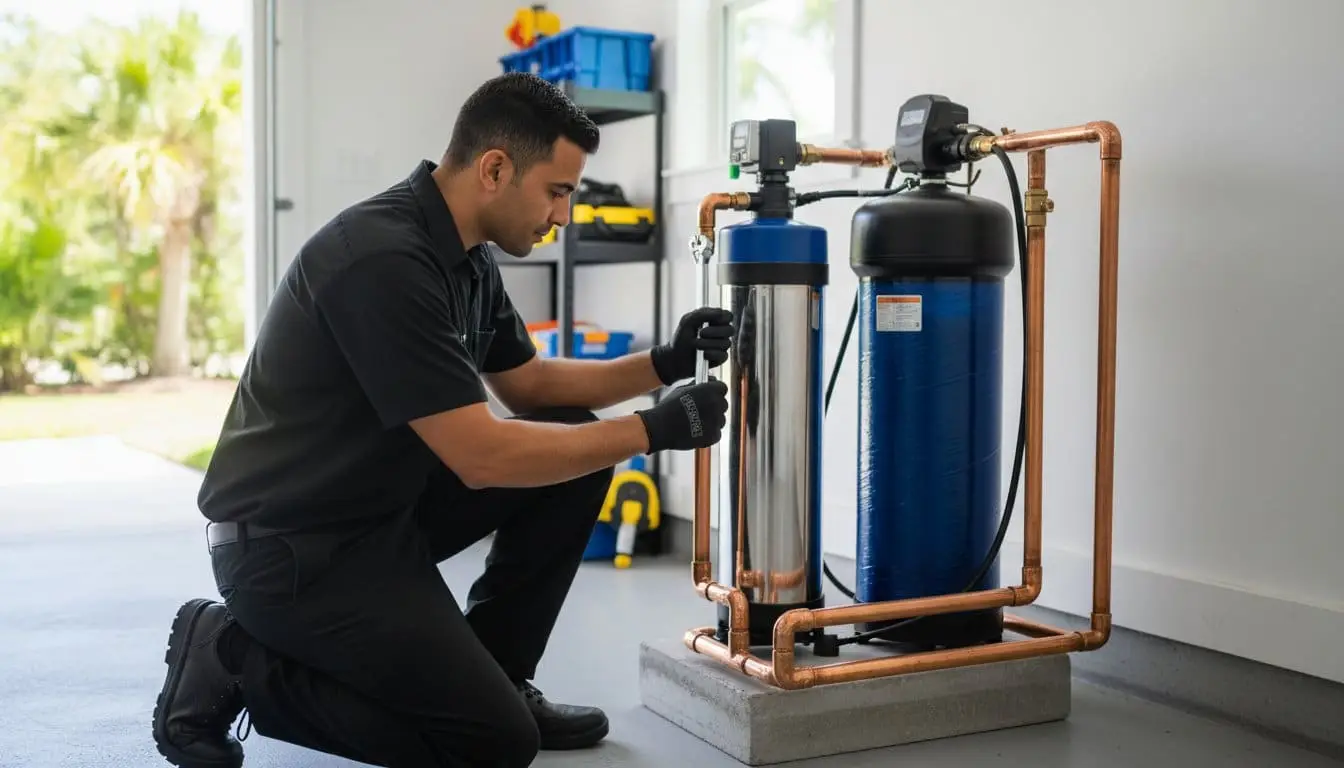
Florida plumbing codes are very specific about how these systems are integrated into your home. Softener discharge must be routed into the sanitary sewer system; it is illegal to drain it into the storm system or onto the ground. We also install backflow prevention devices to ensure treated water never siphons back into the main line. Most local homeowners choose a garage installation to protect the sensitive electronics from Florida’s intense heat and humidity, though we can install sheltered outdoor units if your garage space is limited.
Professional Installation and Maintenance in Port St. Lucie
Professional installation ensures your system operates at peak efficiency from day one. Many DIY kits sold in big-box stores don’t account for the specific flow rates required for larger Florida homes. A professional plumber calibrates the bypass valve and ensures the regeneration cycle doesn’t interfere with your daily water use. Beyond the initial setup, we provide annual tune-ups to check resin health and clean the brine tank; this keeps your investment running for its full 15 to 20-year lifespan.
Protecting your home’s infrastructure is the primary goal. While most people focus on spots on dishes, the real danger is inside your walls. Mineral scale creates turbulent water flow and localized pressure spikes. Over time, this stress contributes to slab leaks, which are incredibly expensive and disruptive to repair. By implementing effective hard water solutions Port St. Lucie homeowners can stop this corrosion before it starts under their foundation.
Integrating Your Solution with Existing Plumbing
If you have a tankless water heater, a softener is practically mandatory. Scale buildup on the heating elements of a tankless unit can cause it to fail in as little as two years. Soft water also interacts differently with your home’s piping. While PEX is generally resistant to minerals, the brass fittings used to connect it can still corrode. Copper pipes are even more vulnerable to the pitting caused by hard water deposits. Our water quality solutions are designed to protect every inch of your plumbing, regardless of the material.
Why Choose First Choice Plus Plumbing & Air?
We aren’t a national franchise. We are your neighbors. Our technicians live and work in areas like Tradition and St. Lucie West, so we know the local water conditions better than anyone. We believe in total transparency. That means you get upfront pricing with no hidden fees or forced salt delivery contracts. We focus on providing the best hard water solutions Port St. Lucie has to offer with the reliability you expect from a master craftsman. Protect your home today with a custom water filtration system.
Take Control of Your Home’s Water Quality Today
Living with 12 GPG water hardness doesn’t have to be a permanent struggle for your family or your plumbing. You now have a clear roadmap to choose between high-efficiency softeners and maintenance-free conditioners based on your specific household needs. Implementing the right hard water solutions Port St. Lucie homeowners trust is the single most effective way to extend the life of your water heater and prevent the silent damage that leads to costly slab leaks.
Our team of certified local plumbers is ready to help you navigate these choices with our upfront pricing guarantee. We understand the unique mineral profile of the Treasure Coast and provide expert calibration that national franchises simply can’t match. Whether you need a system installation or 24/7 emergency service, we’ve got you covered. Get a Professional Water Quality Evaluation in Port St. Lucie and start enjoying the benefits of pure, soft water. You’ve worked hard for your home; let’s make sure your water works for you too.
Common Questions About Port St. Lucie Water Treatment
Is Port St. Lucie water considered hard?
Yes, the water in Port St. Lucie is officially classified as “very hard” with a rating of 12 Grains per Gallon (GPG). While the city uses lime softening at its treatment facilities, the mineral content remains high enough to cause significant limescale buildup. This level is nearly double the threshold where water is first considered hard, making a home treatment system a practical necessity for most residents.
How much does it cost to install a water softener in Port St. Lucie?
A professional water softener installation in the Port St. Lucie area typically costs between $2,000 and $4,000. This price range usually includes the unit itself, professional labor, and the necessary plumbing modifications to integrate the system with your home’s main line. You should also budget for annual maintenance, which averages between $100 and $300 for salt and system checks.
What is the difference between a water softener and a water filtration system?
A water softener specifically targets mineral removal through ion exchange, while a water filtration system focuses on removing contaminants like chlorine, lead, and sediment. Many homeowners choose to combine these hard water solutions Port St. Lucie offers for comprehensive protection. A softener protects your pipes and appliances from scale; whereas a carbon filtration system improves the taste and smell of your drinking water.
Will a water softener fix the sulfur smell in my well water?
No, a standard water softener is not designed to remove the “rotten egg” sulfur smell common in Florida well water. While a softener removes calcium and magnesium, you need a specialized iron or sulfur filter, often using air injection or oxidation, to neutralize those odors. We recommend a comprehensive water test to determine if you need a multi-stage system to handle both hardness and smell.
How long do water softeners typically last in Florida?
Water softeners in Florida typically last between 10 and 15 years with proper care. Our intense heat and high mineral concentrations can be tough on electronics and resin beds, so regular maintenance is vital. Keeping your system in a sheltered area, like a garage, and ensuring the brine tank is cleaned annually will help you get the maximum lifespan out of your equipment.
Can I install a water softener myself, or do I need a plumber?
You should hire a licensed plumber to ensure your system meets the Florida Building Code, especially regarding wastewater discharge. Proper installation requires cutting into your main water line and correctly routing the drain line to the sanitary sewer system. A professional also calibrates the control head to your specific GPG levels, which prevents salt waste and ensures you actually get the soft water you’re paying for.

Article by
Written by First Choice Plus Plumbing & Air Team
This article was created by the team at First Choice Plumbing Solutions, a licensed and experienced plumbing and HVAC company serving Port St. Lucie, Land O’ Lakes, and surrounding areas.
Our team specializes in plumbing and air conditioning services, including drain cleaning, leak detection, water heater repair and installation, AC repair, maintenance, and system installations. Our content is based on real-world experience and the common issues we solve for homeowners and businesses every day.
We aim to provide accurate, helpful, and easy-to-understand information so you can make informed decisions about your plumbing and HVAC needs.
If you need reliable, professional service, First Choice Plumbing Solutions is here to help.
Disclaimer
Disclaimer: The information provided in this article is for general informational purposes only and does not constitute professional plumbing or HVAC advice. Every situation is different, and readers should consult a licensed professional for proper diagnosis and repair. First Choice Plus Plumbing & Air is not liable for any damages or losses resulting from the use of this information.