
If you’re cranking your AC down to 68 degrees to beat the Port St. Lucie humidity, you might actually be making your home feel stickier. Most homeowners think a lower number on the screen always means a more comfortable house, but in the Treasure Coast heat, your thermostat is a humidity-management tool first and a temperature-control tool second. Finding the best temperature to set thermostat in summer Florida isn’t just about a single number. It’s about finding the sweet spot where your system removes moisture effectively without sending your electric bill into orbit.
We understand the stress of watching your power meter spin while the indoor air still feels heavy and damp. It’s a common battle for our neighbors in Stuart and Palm City, especially when Florida’s average residential electricity rate sits around 15.54¢/kWh. This guide will show you exactly how to balance cooling costs with indoor comfort. We’ll preview the ideal settings for when you’re home or away, explain why the “AUTO” fan setting is your best friend, and share professional maintenance tips to keep your system running reliably through the peak of the summer heat.
Key Takeaways
- Aim for 78°F when you’re home to maximize energy savings, but learn how to adjust this based on your home’s specific humidity levels for better comfort.
- Protect your system from an emergency breakdown by following the “20-degree rule,” which helps your AC handle extreme Treasure Coast heatwaves without overworking the motor.
- Find the best temperature to set thermostat in summer Florida for sleeping, typically between 72°F and 74°F, to ensure a crisp and dry indoor environment through the night.
- Keep your thermostat fan set to “AUTO” instead of “ON” to prevent your system from blowing evaporated moisture back into your home, which keeps the air feeling lighter.
- Enhance your indoor air quality and protect your equipment by combining smart temperature settings with UV air sanitizers to prevent mold growth on your cooling coils.
Understanding the Florida Thermostat Balance: Comfort vs. Humidity
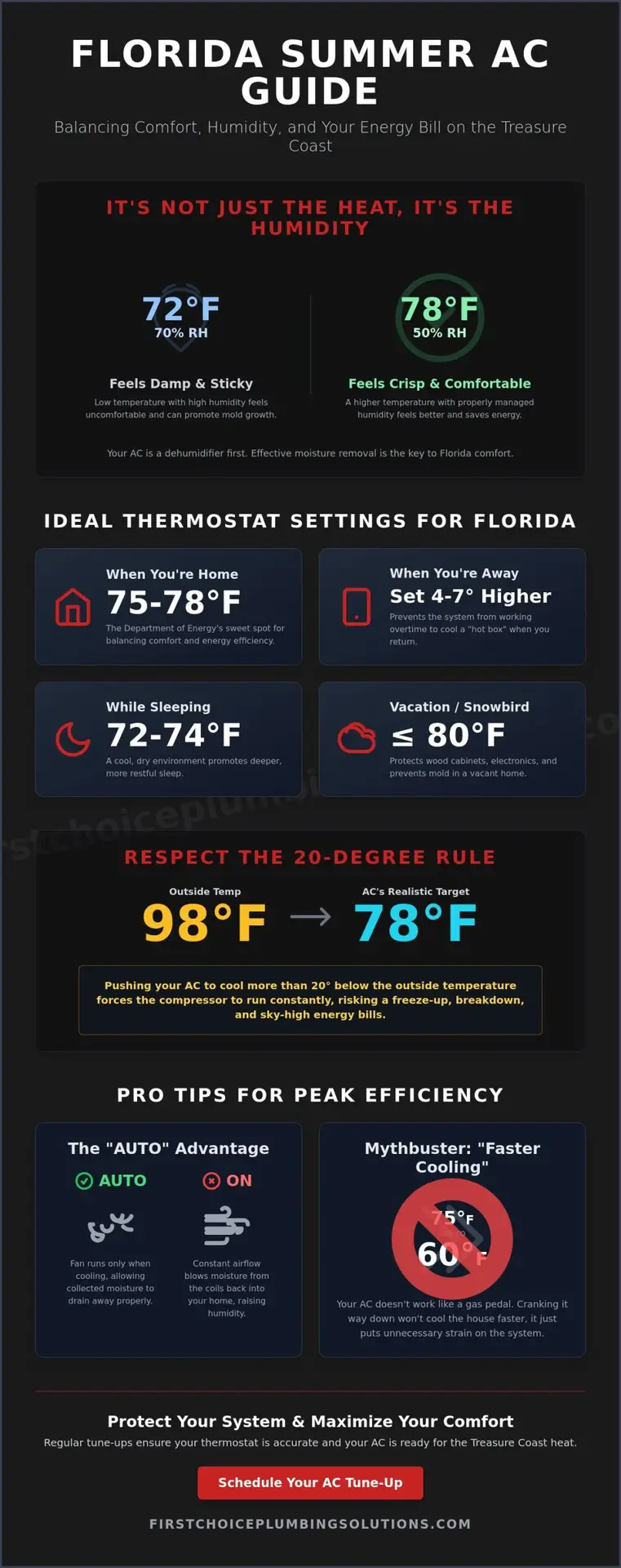
Most residents in Port St. Lucie and Stuart feel the urge to drop the thermostat to 68 degrees as soon as the afternoon sun hits. However, the Department of Energy suggests that 78°F is actually the best temperature to set thermostat in summer Florida for maximum efficiency. While that might sound high, the goal in our climate isn’t just a lower number on the screen; it’s the removal of moisture. An air conditioner is essentially a giant dehumidifier. If you set the temperature too low, the system may cycle off before it has a chance to pull the “heavy” feeling out of the air.
You also need to respect the “20-Degree Rule.” Most residential AC units are designed to cool the air approximately 20 degrees lower than the outdoor temperature. If it’s a blistering 98-degree day in Fort Pierce, your system will struggle to reach anything below 78°F. Pushing for 65°F doesn’t make the air coming out of the vents any colder. It simply forces the compressor to run indefinitely, which leads to sky-high bills and the risk of frozen evaporator coils.
The Role of Relative Humidity in Your Comfort
Relative humidity is the primary factor in Florida indoor comfort. This is why a home set to 78°F with 50% humidity feels significantly crisper and more pleasant than a home at 72°F with 70% humidity. Your AC system only removes moisture while the compressor is actively running. Finding the best temperature to set thermostat in summer Florida means choosing a setting that allows for longer, steady run times rather than short, frequent bursts that leave the air feeling damp and sticky.
The Myth of Faster Cooling
Your HVAC control system doesn’t work like a gas pedal in a car. Cranking the setting down to 60°F won’t cool your living room any faster than setting it to 75°F. The system blows the same temperature air regardless of the target. Setting an unreachable goal just puts unnecessary wear and tear on your compressor and can lead to an expensive emergency repair during the hottest week of July.
Recommended Thermostat Settings for Every Florida Scenario
Daily life in Port St. Lucie requires a flexible strategy. For active hours when your family is home, the best temperature to set thermostat in summer Florida usually falls between 75°F and 78°F. If you live in St. Lucie West, where inland heat traps are common, you might lean toward the cooler end of that range. Conversely, those in Jensen Beach who benefit from consistent coastal breezes might find 78°F perfectly comfortable. The National Weather Service provides excellent resources on how humidity affects temperature, which explains why a slightly higher setting feels great as long as your AC is effectively removing moisture.
When you head to work in Fort Pierce, don’t turn the unit off entirely. Instead, raise the setting by 4 to 7 degrees. This prevents the house from becoming a “hot box” and ensures your system doesn’t have to run for five hours straight to recover when you return. For sleeping, many Treasure Coast residents find that 72°F to 74°F is the ideal sweet spot. This range provides enough cooling to lower your body temperature for deep rest while keeping indoor humidity low enough to prevent that “clammy” feeling on your sheets.
Snowbird and Vacation Settings: Protecting a Vacant House
Many of our neighbors are seasonal residents. If you’re leaving your home vacant for the summer, never set the thermostat above 80°F. Going higher risks more than just a high bill. Excessive heat and stagnant humidity can warp wood cabinets, peel wallpaper, and damage sensitive electronics. We recommend using the “Hold” function rather than a complex schedule during extended absences to ensure the temperature remains consistent regardless of daily fluctuations.
Smart Thermostats: The Treasure Coast Homeowner’s Best Friend
Modern technology makes finding the best temperature to set thermostat in summer Florida much easier. Features like geofencing can detect when you cross the Stuart city limits and start cooling your home before you even pull into the driveway. In Palm City, we highly recommend humidity-sensing models that prioritize moisture removal over raw temperature. To make sure your device is reading your home’s conditions correctly, regular AC tune-ups are essential. A properly calibrated system ensures your smart features actually deliver the savings they promise. If your home never seems to reach the target temperature, a quick professional inspection can often identify a simple sensor or ductwork issue before it becomes an emergency.
Maximizing Efficiency and Preventing Summer AC Emergencies
Your air filter acts as the lungs of the entire HVAC system. When it’s clogged, airflow is restricted, and your thermostat can’t get an accurate reading of the temperature in your living spaces. This leads to longer run times and higher energy bills. For homeowners in Tradition and Jensen Beach, we recommend checking filters monthly during the peak of summer. A clean filter ensures that the air moves freely, allowing your system to reach the best temperature to set thermostat in summer Florida without straining the blower motor.
There is also a powerful synergy between your thermostat settings and UV air sanitizers. Because Florida AC units remove so much moisture, the evaporator coils stay damp, creating a breeding ground for mold. UV lights neutralize these spores before they can colonize your system. Keeping your coils clean maintains the heat-exchange efficiency of your unit, which helps you maintain comfort even when you set the thermostat a few degrees higher to save money.
Don’t forget the power of the “Wind Chill” effect. Ceiling fans don’t actually lower the temperature of a room, but they move air across your skin, making you feel up to 4 degrees cooler. This allows you to raise your thermostat setting from 74°F to 78°F without losing an ounce of comfort. Just remember to turn the fans off when you leave the room; fans cool people, not empty spaces.
The Impact of Indoor Air Quality on Cooling
Clean ductwork is vital for reaching your target temperature quickly. If your ducts are leaky or filled with debris, the conditioned air escapes into your attic or crawlspace before it ever reaches your bedroom. Implementing indoor air quality solutions like high-efficiency filtration and duct sealing keeps the air feeling “crisper.” This allows you to feel comfortable at 77°F, whereas a dusty, humid home might feel oppressive at the same temperature.
Warning Signs Your AC is Struggling
Sometimes the thermostat isn’t the problem. If you notice your unit “short-cycling,” which means it turns on and off every few minutes, your system is likely oversized or suffering from a failing sensor. Conversely, an AC that runs 24/7 without ever reaching your set temperature often indicates low refrigerant or a significant duct leak. If your system is blowing lukewarm air or making strange grinding noises, it’s time to look into emergency AC repair Treasure Coast. Catching these issues early prevents a total system meltdown during a July heatwave.
Stay Cool and Efficient All Summer Long
Finding the best temperature to set thermostat in summer Florida is about more than just picking a number on a screen. It’s about finding that perfect balance between moisture removal and energy savings. By following the 20-degree rule and using ceiling fans to your advantage, you can keep your Treasure Coast home comfortable without overworking your compressor. These small adjustments lead to lower monthly bills and a longer lifespan for your equipment. Consistency is key; avoid drastic temperature swings to keep your indoor air feeling crisp and dry.
Since 2007, First Choice Plus Plumbing & Air has provided expert HVAC solutions under the local leadership of Manuel J. Duran Jr. We take pride in being a dependable pillar of the community, offering 24/7 emergency AC repairs in Port St. Lucie for those moments when the heat becomes too much. Our team is committed to transparency and honest pricing, ensuring your home remains a sanctuary during the hottest months of the year. We’ve spent nearly two decades helping our neighbors in Stuart and Fort Pierce navigate the challenges of the Florida climate.
Schedule your summer AC tune-up with First Choice Plus today! We’re ready to help you enjoy a cool, worry-free summer.
Frequently Asked Questions
Is it cheaper to leave the AC at one temperature or turn it up when I leave?
It’s definitely cheaper to raise your thermostat by 4 to 7 degrees when you leave your Port St. Lucie home for the day. This reduction in the temperature difference between indoors and outdoors slows the flow of heat into your house. Each degree you raise the setting above 72°F can save you roughly 3% on your monthly cooling costs. Just don’t turn the unit off entirely, as cooling a sweltering house from scratch puts immense stress on your compressor.
What is the best humidity level for a Florida home in the summer?
The ideal indoor relative humidity for a Treasure Coast home is between 50% and 55%. Keeping moisture in this specific range prevents mold growth and ensures your skin feels comfortable rather than clammy. Finding the best temperature to set thermostat in summer Florida often involves prioritizing this humidity level over a specific temperature. If your indoor air stays above 60% humidity, your system may need a professional calibration to ensure it’s dehumidifying effectively.
Can I turn my AC off completely while I am on vacation in Florida?
No, you should never turn your AC off completely while vacationing away from Florida. Without active dehumidification, indoor humidity will quickly exceed 70%, which leads to mold on walls and warped cabinetry in Jensen Beach or Stuart homes. Instead, set your thermostat to a steady 80°F. This setting is high enough to keep your electric bill low while ensuring the system runs just enough to keep moisture levels under control and protect your property.
Why does my house feel humid even though the AC is set to 75 degrees?
Your home likely feels humid because the AC system is “short-cycling,” meaning it turns off before it has time to remove moisture from the air. This often happens if your system’s fan is set to “ON” instead of “AUTO.” The “ON” setting blows air over damp coils even when the compressor is off, pushing evaporated moisture back into your rooms. Choosing the best temperature to set thermostat in summer Florida won’t help if your fan is constantly recycling humidity.

Article by
Written by First Choice Plus Plumbing & Air Team
This article was created by the team at First Choice Plumbing Solutions, a licensed and experienced plumbing and HVAC company serving Port St. Lucie, Land O’ Lakes, and surrounding areas.
Our team specializes in plumbing and air conditioning services, including drain cleaning, leak detection, water heater repair and installation, AC repair, maintenance, and system installations. Our content is based on real-world experience and the common issues we solve for homeowners and businesses every day.
We aim to provide accurate, helpful, and easy-to-understand information so you can make informed decisions about your plumbing and HVAC needs.
If you need reliable, professional service, First Choice Plumbing Solutions is here to help.
Disclaimer
Disclaimer: The information provided in this article is for general informational purposes only and does not constitute professional plumbing or HVAC advice. Every situation is different, and readers should consult a licensed professional for proper diagnosis and repair. First Choice Plus Plumbing & Air is not liable for any damages or losses resulting from the use of this information.