
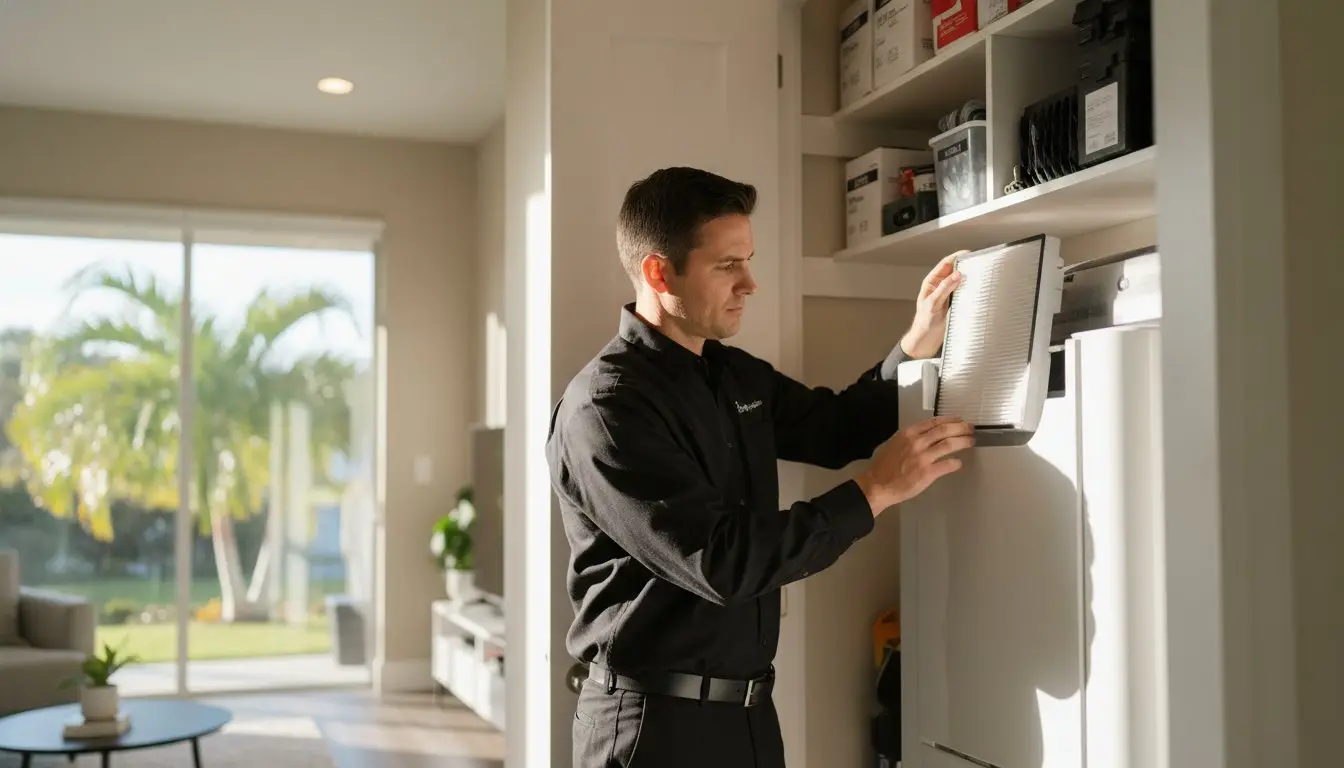
That high-efficiency air filter you bought to protect your family might actually be suffocating your air conditioner. It’s a common frustration for homeowners in Port St. Lucie who deal with musty smells and layers of dust despite frequent cleaning. You want the cleanest air possible, but choosing the wrong MERV rating can restrict airflow, spike your energy bills, and even shorten your HVAC system’s lifespan. Finding the best air filters for Florida homes requires a specific balance between filtration power and the unique demands of our humid Treasure Coast climate.
As of the 2025 ASHRAE updates, the industry standard for residential filtration has officially shifted from MERV 6 to MERV 11. This guide will walk you through these new requirements and explain why the EPA now suggests MERV 13 for superior indoor health. You’ll learn how to select a filter that captures mold spores and allergens without overworking your fan motor. We’ll provide the technical insights you need to ensure your home stays cool and your air stays fresh all year long.
Key Takeaways
- Learn why the 2026 ASHRAE standards now require a minimum of MERV 11 for residential homes to combat Florida’s high humidity and biological growth.
- Discover how to select the best air filters for Florida homes by balancing high-efficiency particle capture with the specific airflow needs of your AC unit.
- Establish a realistic maintenance schedule for the Treasure Coast, including why you should check your filters every 30 to 60 days during the peak summer months.
- Explore how pairing the right filter with a UV air sanitizer can protect your system’s coils from the mold and mildew that filters alone can’t stop.
- Understand the warning signs that your filter is too restrictive, which can lead to higher energy bills and preventable system strain.
Understanding MERV Ratings and the Florida Climate Challenge
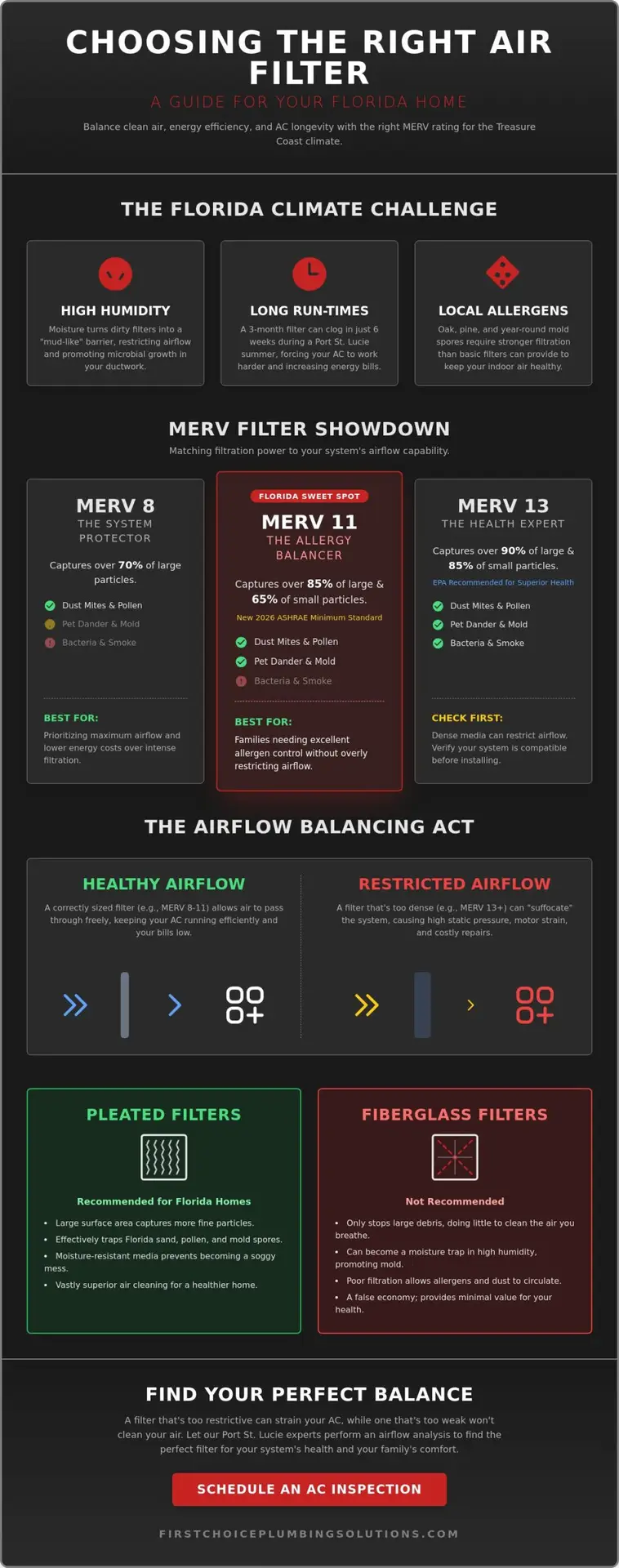
To choose the best air filters for Florida homes, you first need to understand the Minimum Efficiency Reporting Value (MERV). This industry-standard rating measures how effectively a filter captures particles of varying sizes. While the 2025 ASHRAE update now recommends a MERV 11 minimum for residential health, our local environment adds a layer of complexity. In the Treasure Coast, we don’t just fight dust; we fight high humidity and a nearly 12-month cooling season that puts immense pressure on your equipment.
The “Florida Run-Time Factor” is a concept every homeowner in Palm City or Stuart should know. Because our air conditioners run significantly longer than systems in the North, filters reach their saturation point much faster. In 2026, as we see longer periods of extreme heat, a filter that claims to last three months might actually clog in six weeks. When a filter is full, your system works twice as hard to pull air through it, leading to higher bills and unnecessary wear.
The Impact of Florida Humidity on Filter Performance
Our local humidity levels can turn a standard air filter into a moisture trap. When damp air hits a dirty filter, it can create a thick, mud-like barrier that restricts airflow. More importantly, moisture trapped in certain materials can encourage microbial growth right in your ductwork. We suggest using moisture-resistant pleated media. These filters provide a larger surface area to catch debris without becoming a soggy, restrictive mess like cheap fiberglass alternatives often do in the Port St. Lucie heat.
Static Pressure: Why Your AC Needs to Breathe
Static pressure is the resistance to airflow within your HVAC system. If you install a high-MERV filter that is too dense for your specific blower motor, you risk “suffocating” the unit. This resistance forces the motor to run hotter and longer, which is a leading cause of emergency AC repair calls. You must find the “sweet spot” where the filter is thick enough to clean the air but porous enough to keep the air moving freely.
Choosing the Best Filter: MERV 8 vs. MERV 11 vs. MERV 13
Selecting the best air filters for Florida homes requires looking past the marketing and focusing on your specific household needs. Most residential systems in the Treasure Coast utilize one of three common ratings. Each level offers a different trade-off between how much it cleans the air and how much it works your AC motor.
- MERV 8 (The System Protector): This is the baseline for modern homes. It captures over 70% of large particles like dust mites and pollen. It’s an excellent choice for homeowners who prioritize maximum airflow and lower energy costs over intense filtration.
- MERV 11 (The Allergy Balancer): We consider this the “sweet spot” for families in Stuart and Fort Pierce. It traps over 85% of large particles and more than 65% of smaller irritants like pet dander and car fumes. It provides a significant boost in air quality without being overly restrictive.
- MERV 13 (The Health Expert): This is the highest level recommended for standard residential use. The EPA’s guide to MERV ratings notes that MERV 13 filters can capture more than 90% of large particles and over 85% of smaller ones, including some bacteria and smoke. Because these filters are dense, you should verify your system’s compatibility before installation.
Pleated vs. Fiberglass: Which Wins in Port St. Lucie?
Don’t be tempted by the $1 fiberglass filters found at big-box stores. These “throwaway” filters protect your AC’s internal machinery from large debris, but they do almost nothing to clean the air you breathe. Pleated filters are the clear winner for Port St. Lucie homes. Their folded design creates a massive surface area that captures fine Florida sand and microscopic allergens that fiberglass simply misses.
Targeting Local Allergens: Oak, Pine, and Mold Spores
Our local environment dictates your filter needs. During the spring, heavy Oak and Pine pollen can overwhelm a basic filter in Jensen Beach or Palm City. Furthermore, mold spores are a year-round concern due to our constant humidity. A MERV 11 filter is typically the minimum required to effectively manage these biological irritants. If you’re worried about your system’s performance with a higher-rated filter, a professional AC inspection can help determine the ideal fit for your specific equipment.
Maximizing Indoor Air Quality in Your Treasure Coast Home
Choosing the best air filters for Florida homes is only the first step toward a healthy living environment. To maintain that quality, you must commit to a realistic maintenance schedule. While filter packaging often suggests a three-month lifespan, the intense humidity and constant run-times in Port St. Lucie make that timeline risky. During the peak of summer, check your filter every 30 days and replace it at least every 60 days. A clogged filter doesn’t just lower air quality; it forces your system to consume more energy to pull air through the restricted media.
Even the highest-rated filters can’t stop everything. Biological growth often thrives on wet evaporator coils where filters can’t reach. Integrating UV air sanitizers into your HVAC system provides a second layer of defense by neutralizing mold and bacteria on the spot. Regular preventative maintenance ensures your high-efficiency filter is helping rather than hurting your system’s performance. Watch for these warning signs that your filter has reached its limit:
- Visible dust buildup on your supply vents or ceiling fans.
- A faint, musty odor whenever the blower motor kicks on.
- Unexpected increases in your monthly electric bill.
- A whistling or “sucking” sound coming from the intake grate.
When to Upgrade Beyond a Standard Filter
Homeowners in newer communities like St. Lucie West or Tradition often deal with fine construction dust or lingering odors. In these cases, a standard filter might not be enough. You may want to explore advanced indoor air quality solutions like whole-home air purifiers. These systems work in tandem with your filter to scrub the air of microscopic pollutants. Understanding MERV ratings is helpful, but sometimes your specific health needs require more than a one-inch pleated filter can provide.
Professional HVAC Assessment for Older Homes
If you live in an established neighborhood in Stuart or Fort Pierce, your ductwork might not be designed for modern, high-density filters. Before you jump to a MERV 13, have a professional assess your system’s static pressure. We can measure the actual airflow to ensure your equipment can handle the resistance. This prevents the “suffocation” effect mentioned in previous sections and ensures your investment in the best air filters for Florida homes actually results in cleaner air without risking a system breakdown.
Take Control of Your Home’s Air Quality Today
Choosing the best air filters for Florida homes involves more than just picking the highest number on the shelf. You now understand how the 2025 ASHRAE updates have established MERV 11 as the new baseline for residential health and how our local humidity makes a 30 to 60-day replacement schedule essential. Balancing filtration power with proper system airflow is the secret to lower energy bills and a longer-lasting AC unit. By pairing a high-quality pleated filter with advanced solutions like UV air sanitizers, you can effectively combat the mold spores and allergens that thrive in our Treasure Coast climate.
Since 2007, our locally owned and operated team has provided reliable comfort to our neighbors from Jensen Beach to St. Lucie West. We offer 24/7 emergency AC service in Port St. Lucie and specialize in professional UV Air Sanitizer installations to keep your system running at peak efficiency. Don’t let poor air quality or a struggling air conditioner disrupt your peace of mind. Breathe easier with a professional Indoor Air Quality assessment from First Choice Plus! Your family’s comfort is our top priority, and we’re ready to help you optimize your home for a healthier 2026.
Frequently Asked Questions
Is a MERV 13 filter too restrictive for my Florida AC system?
It can be if your HVAC system isn’t specifically designed to handle the increased static pressure. MERV 13 filters are much denser than standard filters, which means your blower motor has to work significantly harder to pull air through the media. If your system is older or your ductwork is undersized, this restriction can lead to frozen coils or a premature motor failure. You should always have a professional measure your system’s airflow before upgrading to this level of filtration.
How often should I really change my air filter in Port St. Lucie?
You should replace your filter every 30 to 60 days to account for the heavy workload of a Florida summer. While many manufacturers suggest a 90-day lifespan, those estimates don’t account for our 10 to 12-month cooling season. The constant operation of your AC in the Treasure Coast means the filter reaches its saturation point much faster. Checking the filter monthly ensures you don’t accidentally “choke” your unit during a record-breaking heatwave.
Can a better air filter help reduce the humidity in my home?
No, air filters are designed to capture airborne particles rather than remove moisture from the air. In fact, a dirty or overly restrictive filter can actually make your home feel more humid. When airflow is restricted, your AC can’t circulate enough air across the evaporator coil to remove moisture effectively. To manage humidity, you need a clean filter that allows for maximum airflow so your air conditioner can perform its secondary job of dehumidification.
What is the best air filter for pet owners on the Treasure Coast?
A MERV 11 pleated filter is typically the ideal choice for households with dogs or cats. This rating is specifically designed to trap pet dander and smaller biological irritants that a standard MERV 8 might miss. For families in Jensen Beach or Palm City, these are often the best air filters for Florida homes because they provide high-level filtration without the extreme airflow resistance that can strain your equipment during the hottest months of the year.
Does the brand of the air filter matter as much as the MERV rating?
The MERV rating is a standardized industry scale, so the rating itself is more important than the name on the box. A MERV 11 filter from any reputable manufacturer will provide a similar level of particle capture. However, you should still look for quality construction. Cheaper, off-brand filters often have flimsy frames that can buckle or collapse under the high-pressure suction of your HVAC system, which allows unfiltered air to bypass the media entirely.
Will a high-efficiency filter lower my monthly FPL bill?
A high-efficiency filter won’t lower your bill on its own, but keeping your filter clean certainly will. Higher MERV filters actually create more resistance, which can cause your system to use slightly more energy than a lower-rated version. The real energy savings come from preventing a clogged filter. By ensuring your system can breathe easily, you prevent the long, inefficient cooling cycles that are the primary cause of high electric bills in our region.

Article by
Written by First Choice Plus Plumbing & Air Team
This article was created by the team at First Choice Plumbing Solutions, a licensed and experienced plumbing and HVAC company serving Port St. Lucie, Land O’ Lakes, and surrounding areas.
Our team specializes in plumbing and air conditioning services, including drain cleaning, leak detection, water heater repair and installation, AC repair, maintenance, and system installations. Our content is based on real-world experience and the common issues we solve for homeowners and businesses every day.
We aim to provide accurate, helpful, and easy-to-understand information so you can make informed decisions about your plumbing and HVAC needs.
If you need reliable, professional service, First Choice Plumbing Solutions is here to help.
Disclaimer
Disclaimer: The information provided in this article is for general informational purposes only and does not constitute professional plumbing or HVAC advice. Every situation is different, and readers should consult a licensed professional for proper diagnosis and repair. First Choice Plus Plumbing & Air is not liable for any damages or losses resulting from the use of this information.