Imagine it is 7:00 AM on a humid Tuesday morning. Your oldest child just finished their shower, the dishwasher is humming in the kitchen, and you finally have a moment to yourself. You step into the stall, but instead of a relaxing steam, you get hit with a bracing, ice-cold blast. If you live in a busy household, you have likely lost the “hot water lottery” more than once. Deciding between a tank water heater vs tankless for large family Florida homes comes down to more than just price. It’s about ensuring your system can keep up with three showers running at once while resisting the heavy mineral scale found in our local water.
You shouldn’t have to choose between a hot shower and a lower electric bill. We understand the stress that comes with outdated equipment and those massive 80-gallon tanks that eat up your entire utility closet. This 2026 guide will show you which heating system handles high demand most efficiently and how to save money on monthly utilities. We will break down the real-world performance of both options, including how they stand up to Florida’s hard water and the latest federal efficiency standards. By the end, you will know exactly which unit will keep the peace in your home for years to come.
Key Takeaways
- Learn why a standard 50-gallon tank often fails to meet the peak-hour demand of a family of five and how to calculate your home’s true “hot water rush hour.”
- Understand the impact of standby energy loss and how heating water only when you need it can significantly reduce your monthly utility expenses.
- Discover how Florida’s hard water affects system longevity and why tankless models are generally more resilient against the sediment buildup common in the Treasure Coast.
- When weighing a tank water heater vs tankless for large family Florida households, consider your long-term residency goals and whether you prioritize lower upfront costs or an endless supply of hot water.
- Identify the infrastructure requirements, such as gas line capacity or electrical panel space, that are essential for a safe and professional high-efficiency installation.
Comparing Tank vs. Tankless for High-Demand Florida Households
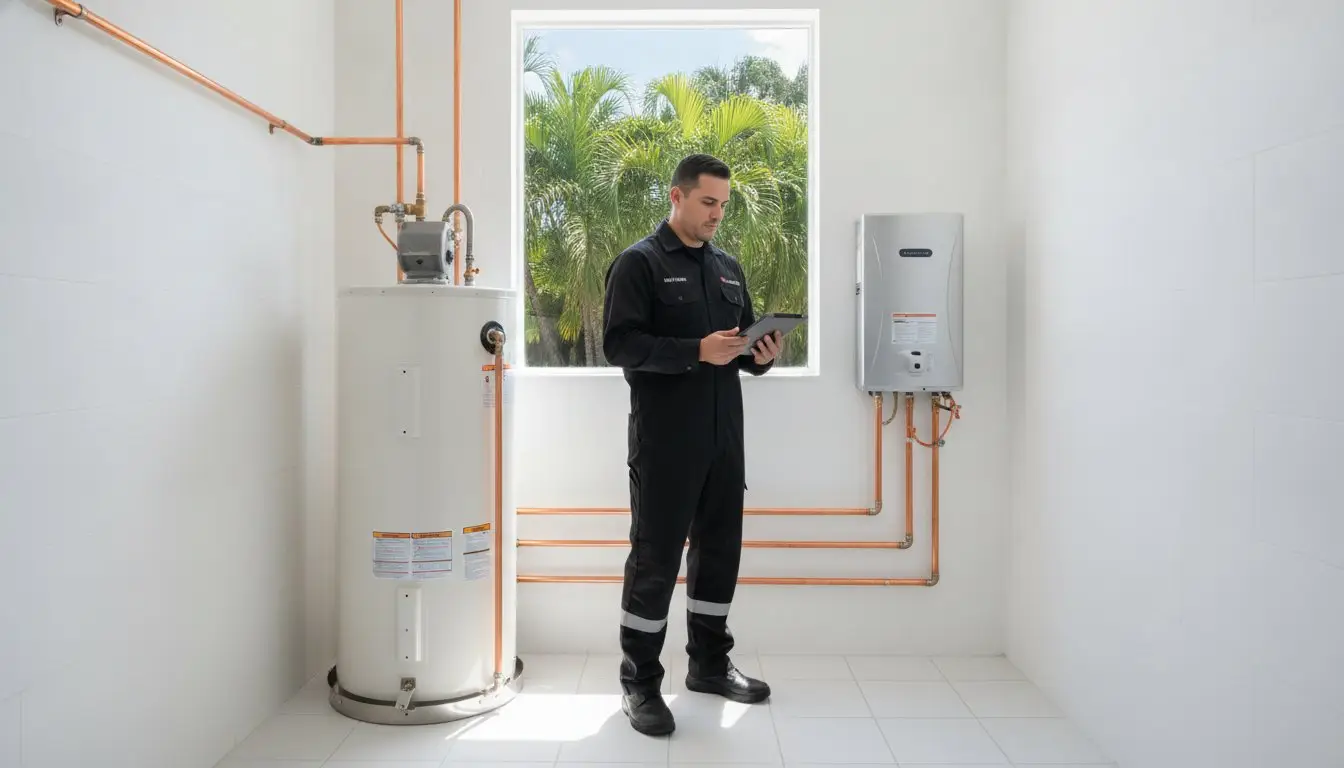
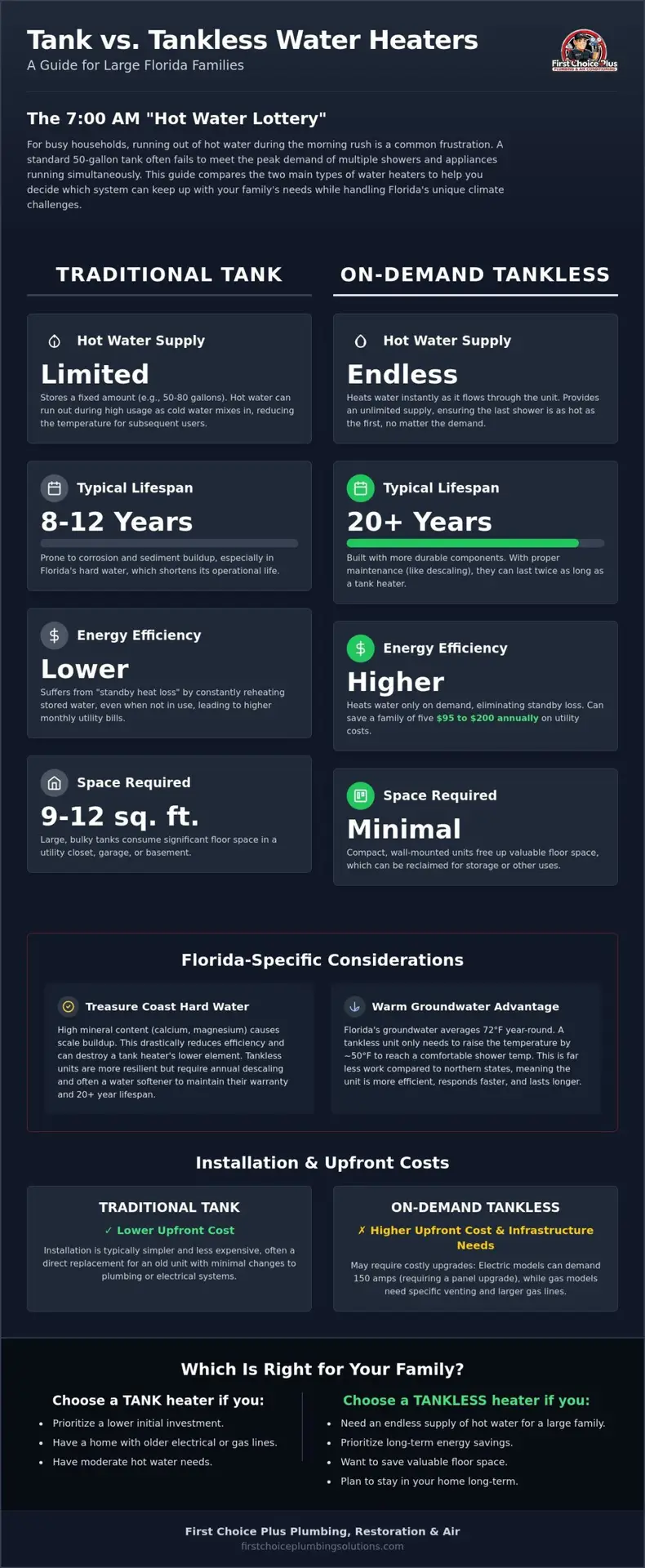
Many homeowners assume an 80-gallon tank is the only way to survive a busy morning. In reality, that massive cylinder often fails a family of five. This happens because traditional tanks suffer from dilution. As you use hot water, cold water rushes in to refill the base, cooling the remaining supply. By the third shower, you’re left with lukewarm water. When weighing a tank water heater vs tankless for large family Florida homes, it’s vital to distinguish endless from instant. Tankless water heaters provide an unlimited stream, meaning the tenth person gets the same temperature as the first. However, the water still takes a few seconds to travel from the unit to your faucet. For households in Stuart or Palm City, switching to a wall-mounted tankless unit also reclaims about 9 to 12 square feet of floor space. That is enough room for a new pantry or extra storage in a crowded utility closet.
Peak Demand: The 7:00 AM Challenge
Managing a large household requires looking at Gallons Per Minute (GPM) rather than total capacity. If two showers are running while the dishwasher cycles, your home might demand 5.5 GPM. Traditional tanks struggle with this simultaneous load because they can’t recover fast enough. Florida residents have a unique advantage here. Our groundwater stays around 72 degrees year-round. This means a tankless unit only needs to raise the temperature by about 50 degrees, whereas a unit in a northern state might have to work twice as hard. Modern high-end models also eliminate the “cold water sandwich,” which is a brief dip in temperature between uses, by using internal buffer tanks.
Lifespan and Reliability in the Florida Climate
The Treasure Coast environment is notoriously tough on appliances. In Port St. Lucie, a standard tank usually lasts between 8 and 12 years before sediment buildup or corrosion takes over. Tankless units are built with more durable components like copper or stainless steel heat exchangers. When properly maintained, these systems can last 20 years or more. If you choose an outdoor installation to save even more space, ensure the unit is rated for our high humidity and salt air to prevent premature cabinet rust.
Efficiency, Hard Water, and the Real Cost of Ownership
Choosing between a tank water heater vs tankless for large family Florida households requires looking past the purchase price to the monthly FPL bill. Standard tanks suffer from standby loss, which occurs as the unit cycles on and off all day to keep 50 or 80 gallons of water hot. This happens even when the kids are at school or you are at work. Tankless models eliminate this waste by heating water only on demand. Because Florida’s groundwater usually stays above 70 degrees, these units reach your desired temperature much faster than they would in colder climates. This natural head start means your system works less and lasts longer, potentially saving a busy family of five between $95 and $200 annually on utility costs.
The Impact of Treasure Coast Water Quality
Water quality in Stuart and Palm City is a major factor in equipment failure. High concentrations of calcium and magnesium create a “rock” of sediment at the bottom of traditional tanks, which eventually burns out the lower heating element. While tankless units don’t store water, they are still vulnerable to scale. Most manufacturers require a water filtration or softener system to maintain the unit’s warranty. Hard water reduces the efficiency of a tankless heat exchanger by up to 15% in just one year. Regular annual descaling is the trade-off for having a system that can last twice as long as a traditional tank.
Installation Hurdles: Gas vs. Electric
Switching to a high-efficiency system isn’t always a simple swap. Electric tankless units for large families often require 120 to 150 amps, which may force a costly electrical panel upgrade. Gas models offer higher flow rates but require specific venting through the roof or an exterior wall to safely exhaust combustion gases. If you’re unsure about your current pipe condition, a professional plumbing inspection can identify if your home’s infrastructure is ready for a high-flow system. We always recommend checking your gas line diameter and venting path before committing to a specific model.
Whether you are installing a high-efficiency tankless unit or a more complex heating system, the technical requirements for gas appliances are significant; experts such as Blueflame Boilers Ltd emphasize that professional installation and routine maintenance are essential for both safety and peak performance.
Choosing the Right System for Your Treasure Coast Home
Deciding between a tank water heater vs tankless for large family Florida households often comes down to your long-term goals and immediate budget. If you need a fast, cost-effective replacement for a failed unit, a high-capacity traditional tank remains a reliable choice. These are straightforward to install and don’t require gas line upgrades or electrical panel modifications. However, if you plan to stay in your home for more than seven years and your family frequently fights over the shower schedule, the investment in a tankless system pays off through comfort and lower utility bills. For those seeking a middle ground, heat pump water heaters are an excellent hybrid option. These units pull heat from our warm Florida air to heat your water, providing incredible efficiency while still using a storage tank.
Homeowner Decision Checklist
Before you commit to a specific model, ask yourself these three questions to narrow down the best fit for your lifestyle:
- Does your family regularly run more than two hot water sources, like a shower and the washing machine, at the same time?
- Are you currently planning to repipe your house or undergo a major bathroom remodel?
- Is your current heater tucked away in a tight closet or a hard-to-reach attic where a smaller, wall-mounted unit would be easier to maintain?
Why Professional Sizing Matters
The most common mistake homeowners make is undersizing their new system. If a tankless unit is too small for your home’s peak demand, you will experience the “lukewarm shower” problem where the water never quite reaches the desired temperature during high-use periods. We calculate the exact flow rate your household requires based on the number of fixtures and your family’s habits. At First Choice Plus, we prioritize local reliability and honest assessments over high-pressure sales tactics. We want you to have a system that works on the hottest summer days and the busiest holiday mornings. Contact our water heater experts today for a custom sizing consultation in Port St. Lucie or Stuart to ensure your family never runs out of hot water again.
Take Control of Your Family’s Morning Routine
Choosing between a tank water heater vs tankless for large family Florida households is a decision that impacts your daily comfort and your long-term budget. Whether you prioritize the lower upfront cost of a traditional tank or the endless supply and space-saving design of a tankless unit, the right choice depends on your specific peak-hour demand. Protecting your investment from our local hard water is just as important as the model you select. By pairing your new system with a proper filtration solution and professional sizing, you ensure your household remains efficient and stress-free for years to come.
Our team of licensed and insured local experts is here to provide the steady hand you need for a seamless transition. We offer 24/7 emergency plumbing availability and transparent, honest pricing so you never have to worry about hidden fees. Don’t let another cold shower ruin your morning. Schedule your water heater consultation with First Choice Plus today! We look forward to helping you find the perfect high-efficiency solution for your Treasure Coast home.
Frequently Asked Questions
Is a tankless water heater worth it for a family of 5 in Florida?
Yes, it is often the best choice for those staying in their home for seven years or more. While the upfront cost is higher, the “endless” hot water is a major lifestyle upgrade for a family of five. When evaluating a tank water heater vs tankless for large family Florida needs, the ability to reclaim closet space and lower monthly utility bills makes it a strategic long-term investment.
Do tankless water heaters work during a power outage in Florida?
Standard tankless units will not operate during a power outage because they require electricity for the control board and ignition. This applies to both electric and gas models. If you want to ensure hot water during a storm, you should look into a dedicated battery backup system. Unlike traditional tanks, tankless units don’t store hot water that remains usable when the power goes out.
How much maintenance does a tankless water heater really need in Port St. Lucie?
Most manufacturers require a professional descaling once per year to maintain the warranty and ensure peak performance. In Port St. Lucie, the high mineral content in the water can lead to scale buildup on the heat exchanger. This yearly service involves flushing the system with a cleaning solution. If you have a whole-home water softener, you might be able to extend the time between these maintenance visits.
Can I run my dishwasher and shower at the same time with a tankless heater?
You can absolutely run multiple appliances at once if your system is sized correctly for your household’s flow rate. A unit with a higher GPM rating can easily support a shower, a dishwasher, and a washing machine simultaneously. Proper sizing is the most critical step in choosing a tank water heater vs tankless for large family Florida homes to avoid any sudden temperature drops during peak morning hours.

Article by
Written by First Choice Plus Plumbing & Air Team
This article was created by the team at First Choice Plumbing Solutions, a licensed and experienced plumbing and HVAC company serving Port St. Lucie, Land O’ Lakes, and surrounding areas.
Our team specializes in plumbing and air conditioning services, including drain cleaning, leak detection, water heater repair and installation, AC repair, maintenance, and system installations. Our content is based on real-world experience and the common issues we solve for homeowners and businesses every day.
We aim to provide accurate, helpful, and easy-to-understand information so you can make informed decisions about your plumbing and HVAC needs.
If you need reliable, professional service, First Choice Plumbing Solutions is here to help.
Disclaimer
Disclaimer: The information provided in this article is for general informational purposes only and does not constitute professional plumbing or HVAC advice. Every situation is different, and readers should consult a licensed professional for proper diagnosis and repair. First Choice Plus Plumbing & Air is not liable for any damages or losses resulting from the use of this information.