
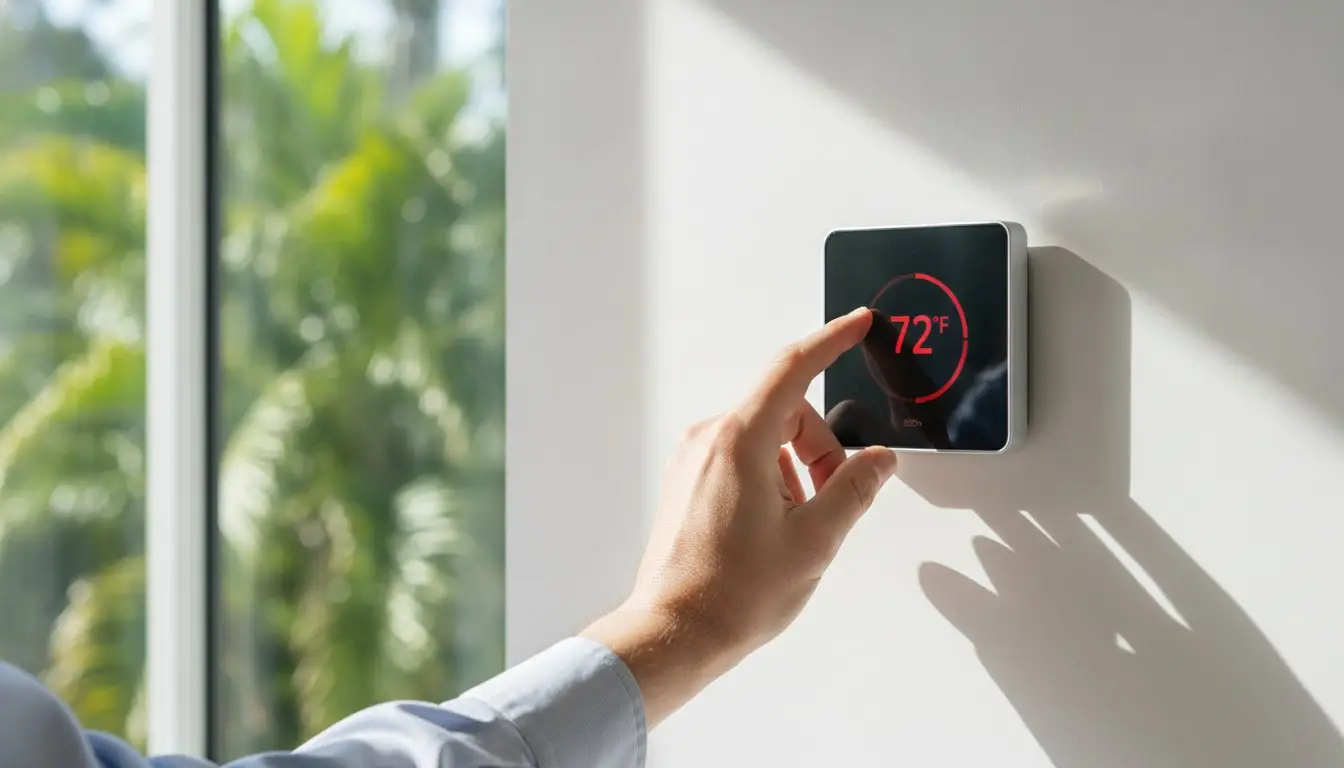
Is your attempt to save money on your monthly FPL bill actually inviting mold into your living room? Many Treasure Coast homeowners struggle with the same dilemma every July. You want to lower those cooling costs, but turning the air conditioner off when you head to work often results in a muggy, stagnant house that takes hours to recover. It is a frustrating cycle where a thermostat set to 78 degrees can easily feel like 85 because of the trapped moisture.
We understand the stress of opening a utility bill that averages $175 or more, but you don’t have to sacrifice your comfort to find relief. Mastering how to set a programmable thermostat for Florida summer savings is about finding the sweet spot between energy efficiency and humidity control. This guide will explain the “4-Degree Rule” for away periods and show you how to leverage 2026 utility rebates to keep your home cool without breaking the bank. We will walk you through the exact settings you need to protect your home and your wallet.
Key Takeaways
- Learn how the “4-Degree Rule” protects your system from overworking during the hottest parts of the day in Stuart or Fort Pierce.
- Master the exact morning and away schedules for how to set a programmable thermostat for Florida summer savings while maintaining a comfortable environment.
- Discover why keeping your humidity in check is the secret to making a 78-degree setting feel significantly cooler.
- Identify how routine maintenance, such as changing filters and cleaning coils, directly impacts your thermostat’s ability to lower your energy bills.
- Implement FPL-recommended temperature ranges to balance monthly utility savings with the long-term health of your HVAC system.
Understanding the Ideal Florida Summer Temperature Ranges
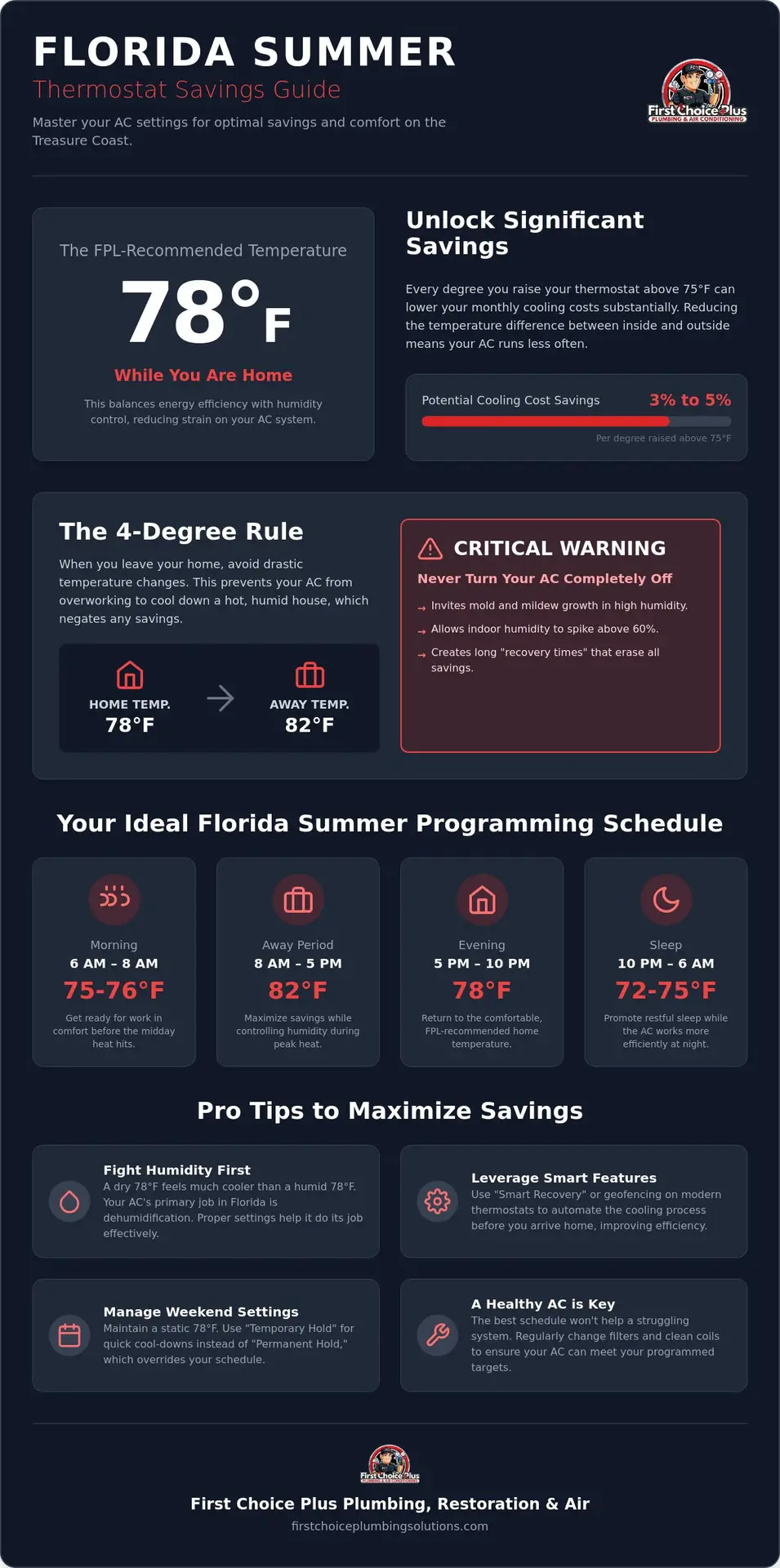
Florida Power & Light (FPL) recommends setting your thermostat to 78 degrees while you are home. This is the foundation for how to set a programmable thermostat for Florida summer savings. While it sounds high to some, it strikes a critical balance between keeping the air dry and keeping your bill manageable. A programmable thermostat helps you maintain this baseline without constant manual adjustments. Every degree you raise the temperature above 75 degrees can save you roughly 3% to 5% on your monthly cooling costs.
We often see homeowners set their AC to 85 degrees or turn it off entirely when they leave for work in Fort Pierce or Stuart. This is a mistake. We recommend the 4-degree rule. Never raise your thermostat more than 4 degrees above your occupied setting. If you stay at 78, don’t go past 82. Florida humidity creates a heavy “recovery time” burden. If the house gets too hot, your system will run for hours just to remove the moisture before the temperature actually drops. This wears out your compressor and negates any savings.
Nighttime requires a different strategy for sleep quality. Most residents find a range of 72 to 75 degrees works best. Since the sun isn’t beating down on your roof, your system doesn’t have to work as hard to maintain these lower temperatures as it would during the day. Use your programming features to start this cooling cycle about 30 minutes before you head to bed.
Why 78 Degrees is the Magic Number for Savings
Heat naturally moves from warm areas to cool ones. When your home is 72 degrees and it is 95 degrees outside, the heat pushes hard against your insulation and windows. For more information on how durable exterior solutions can protect your home’s efficiency, click here. By keeping the home at 78, you reduce that pressure. The smaller the gap between indoor and outdoor temperatures, the slower the heat seeps in. This results in shorter cooling cycles and less strain on your equipment.
The Danger of Turning the AC Completely Off
Turning the AC off in a Tradition or St. Lucie West home is an invitation for mold. Your air conditioner’s primary job in Florida is actually dehumidification. Without it, indoor humidity levels can quickly spike above 60%. This creates a breeding ground for spores on drywall and furniture. Keep the system running on a higher setting to circulate air and pull moisture out of the house even when you aren’t there.
This protection is especially vital for households with pets, who are often more sensitive to indoor air quality and temperature spikes. Beyond maintaining a safe climate, you can support your pet’s health by exploring advanced nutritional options from experts like Garden State Pet Center; find out more about how freeze-dried food can enhance their well-being.
Step-by-Step: Your Florida Summer Programming Schedule
Creating a specific routine is the most effective way to see results. For many residents commuting from Stuart or Fort Pierce, the biggest savings happen while you are at the office. Start your day between 6:00 AM and 8:00 AM by setting the temperature to 75°F or 76°F. This allows you to get ready for work without breaking a sweat, but it prevents the system from running needlessly low before the midday heat hits.
Once you leave for the day, shift into the “Away Period.” Adjusting your settings to 82°F between 8:00 AM and 5:00 PM is a core part of how to set a programmable thermostat for Florida summer savings. When you return home in the evening, aim for the FPL-recommended 78°F. Finally, for the sleep cycle between 10:00 PM and 6:00 AM, drop the temperature to 74°F or 75°F. This range supports deeper rest while avoiding the massive energy waste of keeping the house at 70°F all night long.
Programming for the Monday-Friday Commuter
If you have a modern system, look for “Smart Recovery” or “Adaptive Recovery” settings. These features allow ENERGY STAR certified smart thermostats to learn how long your specific home takes to cool down. Instead of the AC starting a hard cycle at 5:00 PM, it might start gradually at 4:30 PM so the house is exactly 78°F when you pull into the driveway. If your schedule changes frequently, using a geofencing feature can automate this based on your phone’s location.
The Weekend “Stay-at-Home” Adjustment
Weekends often disrupt your energy-saving goals because the house is constantly occupied. We suggest maintaining a static 78°F on Saturdays and Sundays. Avoid using the “Permanent Hold” button, as it overrides your efficient weekday schedule. Instead, use the “Temporary Hold” if you need a quick boost of cool air. If your system seems to struggle reaching these programmed targets even with correct settings, it may be time to schedule emergency AC repair to check for underlying mechanical issues.
Maximizing Savings: Why Your Thermostat Needs a Healthy AC
Even the most precise schedule won’t deliver results if your equipment is struggling behind the scenes. A major hurdle for many homeowners is the “perceived temperature” gap caused by our local climate. If your indoor humidity remains high, that efficient 78-degree setting will feel like a muggy 85. Your air conditioner must act as a dehumidifier first, but when coils are coated in dust or filters are blocked, the system can’t pull moisture effectively. This forces the unit to run longer cycles, driving up costs regardless of your settings.
Maintaining the internal cleanliness of your unit is the secret to making higher temperature settings feel comfortable. We often recommend UV air sanitizers to prevent biological growth on your evaporator coils, which keeps airflow unrestricted. This peak efficiency is essential for how to set a programmable thermostat for Florida summer savings. Without a pre-summer AC tune-up, your system might never reach the 82-degree “away” target you’ve programmed, leading to a compressor that runs non-stop without ever hitting the goal.
Controlling Humidity for Better Comfort at Higher Temps
Set your ceiling fans to rotate counter-clockwise to create a wind-chill effect. While this doesn’t lower the actual room temperature, the moving air helps evaporate moisture from your skin, making you feel roughly 4 degrees cooler. This allows you to stay comfortable at the FPL-recommended 78 degrees. When your AC is well-maintained, it removes humidity so effectively that the air feels crisp and light, preventing that “swampy” feeling that often leads people to crank the thermostat down to 72.
When to Call a Professional for Thermostat Issues
Be alert for signs of thermostat miscalibration or sensor failure. If your AC runs for hours but the temperature on the display never budges, you likely have a mechanical or electrical issue. Upgrading to a smart thermostat can solve many of these problems, offering remote control via your smartphone so you can adjust settings if your schedule changes. First Choice Plus Plumbing & Air provides 24/7 emergency AC repairs throughout Port St. Lucie, Stuart, and Fort Pierce to ensure your home stays efficient all summer long.
Take Control of Your Home Comfort and Energy Costs
Taking charge of your indoor environment doesn’t have to be a guessing game. By applying these strategic settings and keeping your system in peak condition, you can enjoy a cooler home and lower utility bills throughout the hottest months. Mastering how to set a programmable thermostat for Florida summer savings gives you the tools to protect your comfort and your wallet simultaneously, ensuring that your home remains a refreshing sanctuary from the Treasure Coast heat.
First Choice Plus Plumbing & Air has been family-owned and operated since 2007, and we are dedicated to keeping our neighbors comfortable. Our expert local technicians provide 24/7 emergency AC service, ensuring that help is always just a phone call away if your system struggles with the humidity. Ready to maximize your summer savings? Schedule your AC tune-up with First Choice Plus Plumbing & Air today! We look forward to providing the reliable, honest service your home deserves.
Frequently Asked Questions
What is the best thermostat setting for a Florida summer when I am at home?
The best thermostat setting when you are at home is 78 degrees. This is the standard recommendation from Florida Power & Light to keep your electricity bill manageable while maintaining a comfortable indoor climate. If 78 degrees feels too warm, use ceiling fans to create a wind-chill effect. This simple step makes the room feel about 4 degrees cooler without requiring you to lower the AC and increase your energy consumption.
Is it cheaper to leave the AC on all day or turn it off when I leave?
It is always cheaper to leave your AC on at a higher temperature rather than turning it off completely. When you turn the system off, humidity levels spike and the heat soaks into your furniture and walls. This forces the unit to work overtime for hours just to recover. Mastering how to set a programmable thermostat for Florida summer savings involves using the 4-degree rule, which means raising the setting to 82 degrees while you are away.
What temperature should I set my thermostat to at night for the best sleep and savings?
Most Florida residents find that a range of 74 to 75 degrees is ideal for sleep. Since the sun isn’t beating down on your roof at night, your air conditioner can maintain these lower temperatures much more efficiently than during the day. Avoid dropping the temperature below 72 degrees if you want to prevent your monthly bill from climbing. You can program your thermostat to begin this cooling cycle about 30 minutes before your bedtime.
How much can I actually save by raising my thermostat by a few degrees?
You can save approximately 3% to 5% on your monthly cooling costs for every degree you raise the temperature above 75 degrees. For a typical household in our area, these small changes can lead to a noticeable reduction in your monthly FPL bill. To maximize these savings, ensure your system is healthy. A unit with dirty coils or a clogged filter will struggle to hit your targets regardless of how you program the settings.
Will raising the temperature to 80 degrees cause mold in my Florida home?
Setting your thermostat to 80 degrees will not cause mold as long as your air conditioner is functioning correctly and circulating air. Mold thrives on stagnant air and high humidity, usually above 60%. Because your AC acts as a dehumidifier, it continues to pull moisture out of the air even at an 80-degree setting. If you are concerned about moisture or air quality, a professional tune-up can ensure your system is removing humidity as efficiently as possible.

Article by
Written by First Choice Plus Plumbing & Air Team
This article was created by the team at First Choice Plumbing Solutions, a licensed and experienced plumbing and HVAC company serving Port St. Lucie, Land O’ Lakes, and surrounding areas.
Our team specializes in plumbing and air conditioning services, including drain cleaning, leak detection, water heater repair and installation, AC repair, maintenance, and system installations. Our content is based on real-world experience and the common issues we solve for homeowners and businesses every day.
We aim to provide accurate, helpful, and easy-to-understand information so you can make informed decisions about your plumbing and HVAC needs.
If you need reliable, professional service, First Choice Plumbing Solutions is here to help.
Disclaimer
Disclaimer: The information provided in this article is for general informational purposes only and does not constitute professional plumbing or HVAC advice. Every situation is different, and readers should consult a licensed professional for proper diagnosis and repair. First Choice Plus Plumbing & Air is not liable for any damages or losses resulting from the use of this information.