
If you live in St. Lucie West but pay your bill to the City, you might be surprised to find your neighbor across the street has a completely different utility provider. Understanding city water port st lucie can be confusing, especially with the 3.5% rate increase that took effect for the 2025-2026 fiscal year. You’ve likely noticed that while the city meets safety standards at the treatment plant, the water leaving your tap still leaves behind that frustrating white scale on your fixtures.
We know it’s stressful to see your water bill climb to $5.23 per 1,000 gallons for the first block of usage while worrying about the health of your pipes. This guide provides the clarity you need to navigate the local water system, manage your 2026 utility costs, and protect your home from Florida’s harsh water conditions. We’ll show you how to distinguish between service areas, use leak detection to lower your bills, and choose the right filtration to keep your appliances running efficiently for years.
Key Takeaways
- Understand the 2026 rate increases and identify your specific utility provider to better manage your monthly household budget.
- Learn how the mineral content in city water port st lucie causes scale buildup that shortens the lifespan of your dishwasher and water heater.
- Discover the simple steps to read your water meter and catch silent leaks before they result in a spike on your utility statement.
- Find out how whole-home water softeners protect your faucets and pipes from the corrosive effects of chlorine and hard minerals.
- Compare point-of-use and whole-home filtration options to ensure your family enjoys the highest quality water at every tap.
Understanding the Port St. Lucie City Water System
The City of Port St. Lucie Utility Systems Department manages the primary infrastructure for city water port st lucie, serving over 97,000 customer connections. This massive network draws water from the Floridan Aquifer, a deep underground source that provides the bulk of the region’s supply. To ensure safety and clarity, the city utilizes a reverse osmosis treatment process at the James E. Anderson facility. While the city provides water to the vast majority of residents in Port St. Lucie, Florida, your specific neighborhood determines which rules and rates apply to your home.
Following the 3.5% rate increase that took effect on October 1, 2025, for the 2025-2026 fiscal year, homeowners should prepare for adjusted monthly costs. For the first 5,000 gallons of usage, the rate is now $5.23 per 1,000 gallons. If your usage exceeds 12,000 gallons, that rate jumps to $8.38. Wastewater rates have held steady at $8.27 per 1,000 gallons. These tiered structures are designed to encourage conservation, but they also mean a small leak can quickly lead to an expensive surprise on your utility statement.
Service Areas: Tradition, St. Lucie West, and Beyond
Identifying your provider is the first step in managing your home’s plumbing. Most residents in Tradition and the newer southern developments are direct customers of the City of PSL. However, if you live in St. Lucie West, you likely receive services from the St. Lucie West Services District (SLWSD). This independent district has its own billing cycles and storm protocols. When you need to start or transfer your water service, confirming your specific district prevents delays. Each entity has different requirements for emergency shut-offs and meter access, which is vital information during a pipe burst or major repair.
Setting Up Your Utility Account in 2026
Establishing a new account requires a few specific steps to ensure a seamless connection. You’ll need to provide a government-issued ID and proof of residency, such as a closing statement or lease agreement. The city requires deposits for new accounts, and you can expect a monthly base facility charge of $11.16 for a standard residential water meter. For wastewater, the base charge is $17.65. You can submit these documents through the city’s online portal or visit the utility office in person to finalize your connection before move-in day.
Water Quality and the Impact on Your Home’s Plumbing
While the 2024 Water Quality Report confirms that city water port st lucie meets all EPA standards, including the strict new limit of 4.0 parts per trillion for PFAS, what happens at the treatment plant isn’t the whole story. By the time that water reaches your kitchen sink, it carries a heavy mineral load from the Floridan Aquifer. This “hard water” is safe to drink but creates a constant chemical battle inside your pipes. Beyond minerals, the chlorine used to keep the supply bacteria-free can be surprisingly aggressive toward your plumbing fixtures. Over time, this disinfectant dries out and cracks the rubber flappers in your toilets and the O-rings in your designer faucets, leading to annoying drips and wasted water.
There’s also a hidden connection between municipal water pressure and slab leak risks. Many older Treasure Coast homes were built with copper pipes installed directly under the concrete foundation. When the city’s high-pressure delivery meets pipes already thinned by decades of mineral friction, tiny pinhole leaks can form. These leaks often go unnoticed until you see a spike in your utility bill or feel a warm spot on your floor. Meeting safety standards ensures the water won’t make you sick, but it doesn’t guarantee the water is “soft” or gentle on your home’s infrastructure.
Dealing with Hard Water in Port St. Lucie
Hard water is defined as water containing high levels of dissolved calcium and magnesium picked up as it filters through Florida’s limestone-rich underground aquifers. You’ll see the evidence in white, chalky spots on your glassware and a film on your shower doors. This mineral scale is a silent killer for your water heater. As the minerals settle at the bottom of the tank, they create an insulating layer that forces the unit to work harder and run longer, which eventually burns out the heating element. If you notice your skin feels itchy or your soap won’t lather, your home is likely struggling with these local water conditions.
Protecting Your Pipes from Corrosion
Homes built before 2000 in neighborhoods like Sandhill Crossing or Riverview often rely on aging copper systems that weren’t designed for today’s water chemistry. The combination of high mineral content and chlorine can cause internal pitting. If you’ve already dealt with more than one leak in a year, whole house repiping is often the most cost-effective way to prevent a catastrophic flood. Upgrading to modern, corrosion-resistant materials ensures your plumbing can handle the local water supply without fail. If you’re concerned about the state of your pipes, our team can perform a quick plumbing inspection to check for early signs of trouble.
Managing Usage and Preventing High Water Bills
With residential water rates reaching $8.38 per 1,000 gallons for high-usage tiers in 2026, a single running toilet can add hundreds of dollars to your monthly bill. Monitoring your city water port st lucie usage is the most effective way to avoid these budget-breaking spikes. Most meters are located in a concrete or plastic box near the street. To track your daily consumption, read the numbers from left to right, just like a car’s odometer. If you see the dial spinning while all faucets and appliances are off, you have an active leak that requires immediate attention.
The city is currently transitioning to digital tracking through a 2026 Smart Meter rollout. These new systems allow the utility department to detect constant flow patterns that suggest a leak, often notifying you via a digital alert before the bill arrives. If you still have an analog meter, you can perform a simple overnight test. Record the reading before bed and check it again first thing in the morning. If the numbers changed while your family was asleep, a plumbing issue is definitely present. This simple habit helps you distinguish between a utility error and a genuine home maintenance problem.
Detecting Hidden Leaks Before They Cause Damage
A silent toilet leak is the most common reason for a sudden jump in your city water bill. You can identify this in 15 minutes by placing a few drops of food coloring into the toilet tank. If the color appears in the bowl without flushing, the flapper valve is worn out and needs replacement. You should also watch the low-flow indicator on your meter, which is usually a small red or silver triangle. If it’s moving even slightly, water is escaping somewhere in your system. For complex issues like underground pipe failures or slab leaks, it’s best to schedule professional leak detection to pinpoint the exact location without damaging your property. If a leak does occur, knowing what to do after a water leak in Port St. Lucie can help you act quickly, protect your insurance claim, and prevent costly mold damage within the critical 48-hour window.
Water Conservation Tips for Florida Summers
Florida’s heat often tempts homeowners to over-water their lawns, but Port St. Lucie enforces mandatory irrigation schedules based on your house number. Limiting your watering to the designated days prevents fines and keeps you within the lower, more affordable rate blocks. Installing low-flow showerheads and faucet aerators is another smart strategy. These modern fixtures reduce total volume by up to 30% without a noticeable loss in pressure. If your bills remain high despite these efforts, schedule a plumbing inspection today to identify and fix hidden inefficiencies.
Professional Solutions for Better Home Water Quality
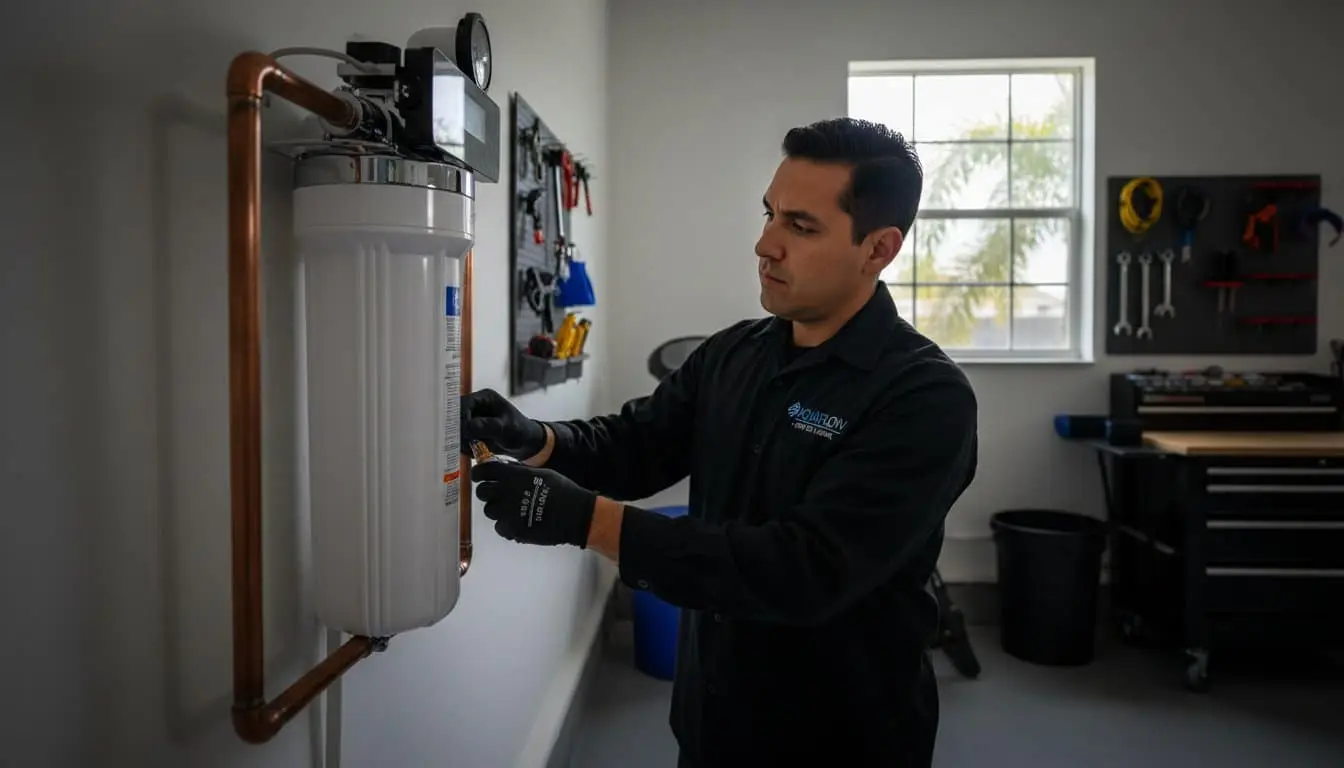
The city handles the heavy lifting of treatment and distribution, but the final quality of the water entering your home is your responsibility. You can choose between point-of-use filters, which only treat water at a single faucet, or whole-home systems that protect every pipe in your house. For most homeowners dealing with city water port st lucie, water softeners are the gold standard. These systems remove the heavy calcium and magnesium minerals before they can settle in your pipes or appliances. If you want bottled-water quality for drinking and cooking, a Reverse Osmosis (RO) system at the kitchen sink is the most effective solution. To keep these systems running at peak performance, you should change sediment filters every six months and schedule a professional check-up once a year.
Is a Water Softener Right for Your PSL Home?
Investing in a softener often pays for itself by extending the life of your expensive appliances. Without one, the hard minerals found in city water port st lucie can cut the lifespan of a dishwasher or washing machine by 30% or more. These water quality solutions improve the efficiency of your tankless water heater by preventing scale from coating the heating elements. Scale acts as an insulator, forcing your heater to use more energy to reach the desired temperature. A softener ensures your system runs lean and lasts for its full expected service life.
Taking Action: Your Next Steps for Water Safety
The best way to start is with a professional water hardness test to see exactly what is in your supply. You can also evaluate your home’s plumbing health with a comprehensive inspection to look for existing scale damage or early signs of corrosion. Our team at First Choice Plus Plumbing & Air is ready to help you navigate these choices with a personalized water quality consultation. We’ve got you covered with upfront pricing and reliable experts who understand the unique needs of Port St. Lucie homeowners. Fix your water quality issues today to ensure your home remains a place of comfort and safety.
Secure Your Home’s Plumbing for the Years Ahead
Managing your city water port st lucie involves more than just paying a monthly bill. It requires staying ahead of the 3.5% rate increases and ensuring that high mineral levels don’t destroy your water heater or dishwasher from the inside out. By using simple dye tests and regular meter checks, you can stop silent leaks before they drain your household budget. Proactive maintenance is the only way to counteract the natural wear and tear caused by Florida’s unique water chemistry.
First Choice Plus Plumbing & Air has served the Port St. Lucie community since 2007. We are local experts who understand how Treasure Coast infrastructure impacts your home’s pipes. Whether you need a long-term filtration plan or 24/7 emergency support for a sudden leak, we’ve got you covered with upfront pricing and reliable service. We pride ourselves on being the steady hand that resolves home maintenance stress for our neighbors.
Don’t let hard water and hidden leaks dictate your utility costs. Schedule your Port St. Lucie water quality test today with First Choice Plus! Taking this simple step now protects your appliances and ensures your family enjoys clean, soft water at every tap for years to come.
Frequently Asked Questions
How do I set up my city water account in Port St. Lucie?
To establish your utility account, contact the City of Port St. Lucie Utility Systems Department at 772-873-6400 or use their online customer portal. You’ll need to provide a government-issued ID and a copy of your lease agreement or closing statement to prove residency. For a standard 5/8″ x 3/4″ residential meter, expect a monthly base facility charge of $11.16 for water and $17.65 for wastewater as of the 2025-2026 fiscal year.
Why is my Port St. Lucie water bill so high this month?
Sudden spikes in your city water port st lucie bill are usually caused by silent toilet leaks or faulty irrigation timers that run longer than intended. A worn-out toilet flapper can waste up to 200 gallons of water per day without making a sound. With the 2026 rate for Block 3 usage set at $8.38 per 1,000 gallons, even a small leak can quickly push your bill into the most expensive pricing tier.
Is the water in Port St. Lucie considered ‘hard’?
Yes, the water in Port St. Lucie is considered hard because it’s sourced from the mineral-rich Floridan Aquifer. As the water travels through underground limestone, it picks up high concentrations of calcium and magnesium. While the city’s reverse osmosis treatment facility removes many impurities, the remaining minerals often cause white scale buildup on your showerheads and can reduce the efficiency of your water heater over time.
Who do I call for a water leak in the street versus my house?
You should call the City of Port St. Lucie Utility Systems at 772-873-6400 if you see water pooling in the street or leaking from the meter box itself. For any leaks located on your side of the meter, including the service line leading to your home or any interior pipes, you must contact a licensed plumber. The city’s responsibility ends at the meter connection, so repairs to the house’s plumbing are the homeowner’s responsibility. Once the immediate flow is stopped, following the proper steps for what to do after a water leak in Port St. Lucie will help you document the damage correctly and meet Florida’s 2026 insurance claim deadlines.
What are the current watering restrictions in Port St. Lucie?
Mandatory watering restrictions in Port St. Lucie limit landscape irrigation to two designated days per week based on your street address. Odd-numbered addresses may water on Wednesdays and Saturdays, while even-numbered addresses are restricted to Thursdays and Sundays. You must never irrigate between 10:00 AM and 4:00 PM. These rules help manage the city water port st lucie supply and ensure there’s enough pressure for fire protection and daily household needs.
Does Port St. Lucie water contain fluoride?
Yes, the city adds fluoride to the water supply to meet the 0.7 milligrams per liter target recommended by the U.S. Department of Health and Human Services. This practice is intended to help prevent tooth decay across the community. If you prefer to have fluoride-free water for drinking or cooking, you can install a point-of-use Reverse Osmosis system to filter it out at your kitchen tap.

Article by
Written by First Choice Plus Plumbing & Air Team
This article was created by the team at First Choice Plumbing Solutions, a licensed and experienced plumbing and HVAC company serving Port St. Lucie, Land O’ Lakes, and surrounding areas.
Our team specializes in plumbing and air conditioning services, including drain cleaning, leak detection, water heater repair and installation, AC repair, maintenance, and system installations. Our content is based on real-world experience and the common issues we solve for homeowners and businesses every day.
We aim to provide accurate, helpful, and easy-to-understand information so you can make informed decisions about your plumbing and HVAC needs.
If you need reliable, professional service, First Choice Plumbing Solutions is here to help.
Disclaimer
Disclaimer: The information provided in this article is for general informational purposes only and does not constitute professional plumbing or HVAC advice. Every situation is different, and readers should consult a licensed professional for proper diagnosis and repair. First Choice Plus Plumbing & Air is not liable for any damages or losses resulting from the use of this information.