
Table of Contents
- Signs You Need Emergency AC Repair Right Now
- What to Do When Your AC Breaks Down: Step-by-Step
- DIY Emergency AC Repair: What You Can Safely Fix Yourself
- 24 Hour Emergency AC Repair: What Happens When You Call
- Common AC Problems Our Technicians Fix on the Same Day
- Emergency AC Repair Cost: What Affects Your Bill
- How 24 Hour Emergency AC Repair Fits Into Preventative Maintenance
- Conclusion
Last Updated: July 31, 2026
Florida summers are unforgiving, and a failed cooling system is not a minor inconvenience. When your AC stops working at 11 p.m. in Port St. Lucie with heat indexes above 100°F, you need 24 hour emergency ac repair from a team that actually shows up. At First Choice Plus Plumbing & Air, we respond to cooling emergencies across St. Lucie and Martin Counties around the clock, with a 1-hour service window so you know exactly when help is arriving. Below, we’ll walk you through how to identify a true emergency, what you can do before the technician arrives, and what to expect when you call.
Emergency ac repair is not always obvious. Some failures are immediate and dangerous. Others are inconvenient but can wait until morning. Knowing the difference saves you money and gets you the right level of help, fast.
Signs You Need Emergency AC Repair Right Now
Your cooling system gives clear warning signs before a full breakdown, but some failures demand immediate attention. According to the U.S. Department of Energy’s guidance on home cooling systems, extreme heat events pose real health risks for vulnerable populations, and a non-functional AC in summer heat qualifies as a home safety concern, not just a comfort issue.
Emergency vs. Non-Emergency: How to Tell the Difference
Not every AC problem warrants a midnight service call. Here is a practical breakdown:
|
Situation |
Emergency? |
Reason |
|---|---|---|
|
No cool air, indoor temp above 85°F |
Yes |
Health risk, especially for elderly or children |
|
Burning smell or visible smoke |
Yes |
Electrical fire hazard |
|
Ice forming on air handler or lines |
Yes |
Indicates refrigerant or airflow failure |
|
Loud banging or grinding noise |
Yes |
Compressor or motor damage worsening by the minute |
|
Thermostat unresponsive |
Possibly |
Check breaker first; may not require emergency dispatch |
|
Slightly reduced cooling output |
No |
Schedule same-day or next-day service |
|
Increased energy bill, system still running |
No |
Routine diagnostic visit is sufficient |
The rule of thumb: if the failure creates a health risk or will cause additional mechanical damage if left running, it is an emergency. If the system is operating but underperforming, it can wait for a scheduled service call.
What to Do When Your AC Breaks Down: Step-by-Step
Most homeowners panic when the AC fails. That is understandable. But a few quick checks can either resolve the problem entirely or give the technician critical information before they arrive, which speeds up the diagnostic visit and may reduce your final bill.
Step 1: Check Your Thermostat and Circuit Breaker
Start here before anything else. A surprising number of emergency calls trace back to a tripped breaker or a thermostat set to “fan only” instead of “cool.” Check the thermostat display, confirm it is set to cool and the target temperature is below the current room temperature. Then check your electrical panel for a tripped breaker labeled “AC,” “air handler,” or “condenser.”
Reset the breaker once. If it trips again immediately, stop. A repeatedly tripping breaker indicates an electrical fault inside the cooling system, and that is a job for a licensed technician, not a DIY fix.
Step 2: Inspect the Air Filter and Condenser Unit
A severely clogged air filter can cause the system to freeze up or shut down entirely. If you have not changed your filter in the past 30 to 90 days, check it now. A filter so clogged you cannot see light through it is restricting airflow enough to cause system failure.
Outside, check the condenser unit. Make sure it is not blocked by debris, overgrown vegetation, or a covering that was left on. The condenser needs clear airflow on all sides to reject heat properly. Clear any obvious obstructions, but do not attempt to open the unit or handle refrigerant lines.
Step 3: Keep Your Home Cool While You Wait
While you wait for the technician, take practical steps to reduce heat gain:
- Close blinds and curtains on sun-facing windows
- Move to the lowest floor of the home (cooler air settles)
- Use ceiling fans on the highest setting to circulate air
- Avoid using the oven or other heat-generating appliances
- Place a bowl of ice in front of a box fan for temporary spot cooling
These measures will not replace a working cooling system, but they make the wait safer and more comfortable, particularly for children, elderly family members, or pets.
DIY Emergency AC Repair: What You Can Safely Fix Yourself
The honest answer: very little. But “very little” is not nothing.
What you can safely address yourself:
- Replacing a dirty air filter – This is always safe and sometimes resolves reduced airflow immediately
- Resetting a tripped breaker – One reset attempt is fine; repeated tripping means stop
- Clearing debris from the condenser unit – Leaves, grass clippings, and dirt blocking the fins can be gently cleared
- Checking and replacing thermostat batteries – A dead thermostat battery causes the same symptoms as a failed control board
What you should never attempt without a license:
- Handling refrigerant. Federal law under Section 608 of the Clean Air Act prohibits handling refrigerants without EPA certification. This is not a gray area.
- Opening the electrical components of the air handler or condenser
- Attempting to “recharge” the system yourself with refrigerant kits sold online
A refrigerant leak is one of the most common causes of emergency AC failure, and it requires a licensed technician with proper equipment to diagnose and repair safely. As noted by the EPA’s guidance on refrigerant handling regulations, improper handling of refrigerants carries both environmental and legal consequences.
24 Hour Emergency AC Repair: What Happens When You Call
The moment you call for 24 hour emergency ac repair, the process is straightforward. A dispatcher takes your information, confirms your location within St. Lucie or Martin County, and schedules a technician within the 1-hour service window. There is no vague “sometime this afternoon” response.
Licensed and Insured Technicians On-Call Around the Clock
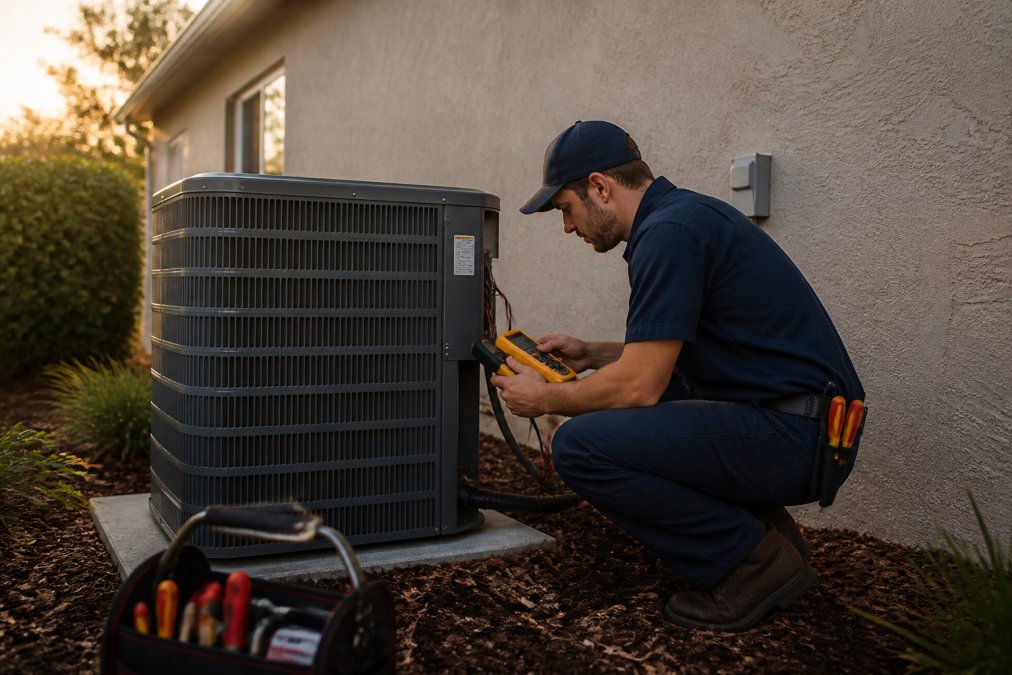
Every technician dispatched for an emergency call is licensed and insured. This matters more than most homeowners realize. An unlicensed technician working on your HVAC system can void your equipment warranty, create liability issues if something goes wrong, and in Florida, violates state contractor licensing requirements. The technician who arrives will diagnose the problem, explain the findings clearly, and give you an upfront price before any work begins.
Customers notice this approach. As one recent client put it: “Jayden did a great job. Checked everything and discussed his findings with us. We appreciate him coming so soon and taking good care of us.” That kind of transparency is the standard, not the exception.
What Our 1-Hour Service Window Actually Means for You
A 1-hour service window means you are given a specific one-hour block, not a four-hour range. This is a real commitment. One of the most common frustrations homeowners raise before booking is: “How do I know you’ll actually show up? I’ve had technicians tell me they’re coming and never show.” The 1-hour window is the direct answer to that concern. You can plan around it. You do not need to take the entire day off work or sit waiting indefinitely.
Common AC Problems Our Technicians Fix on the Same Day
Same-day service covers the vast majority of residential HVAC failures. The most common issues resolved in a single visit include:
- Refrigerant leaks – Locate the leak, repair it, and recharge the system to manufacturer specifications
- Compressor failure – Diagnose whether the compressor needs repair or replacement; many are resolved same-day with stocked parts
- Capacitor failure – One of the most common causes of a system that hums but will not start; typically a fast repair
- Thermostat issues – Faulty wiring, failed control boards, or miscalibrated thermostats
- Frozen evaporator coils – Caused by restricted airflow or low refrigerant; thaw, diagnose, and correct the root cause
- Electrical component failures – Contactors, relays, and disconnect issues in the condenser unit
- Clogged condensate drain lines – Causes water backup and system shutoff; cleared quickly with the right equipment
The technician arrives equipped to handle these repairs, not just diagnose them. “Jessie was extremely knowledgeable and informative and was transparent. A genuine person and an asset to your team,” noted one customer after a recent service call. That combination of technical skill and clear communication is what separates a good emergency visit from a frustrating one.
Emergency AC Repair Cost: What Affects Your Bill
The emergency ac repair cost question is the one most homeowners ask before booking, and rightly so. Nobody wants to call for help and then face a bill they were not prepared for.
Several factors influence the final cost of an emergency repair:
- Time of day – After-hours calls typically carry a higher service fee than standard business hours
- Nature of the repair – A capacitor swap costs far less than a compressor replacement
- Parts availability – Common parts are typically stocked on the truck; specialty components may require a return visit
- Age and condition of the system – Older systems sometimes reveal secondary problems during diagnosis
- Refrigerant type – Newer refrigerant types required by current EPA regulations are priced differently than legacy refrigerants
First Choice Plus Plumbing & Air uses upfront pricing, which means the technician provides the full cost before any work begins. You approve the price before anything is touched. Visit the First Choice Plus Plumbing & Air pricing page for current service rates, or ask the dispatcher when you call. There are no surprise additions to the final bill.
How 24 Hour Emergency AC Repair Fits Into Preventative Maintenance
Here is where most guides stop short. Emergency repairs fix the immediate failure. Preventative maintenance prevents the next one.
The ENERGY STAR program guidance on HVAC maintenance recommends annual professional maintenance for residential cooling systems, including coil cleaning, refrigerant level checks, and electrical component inspection. Homeowners who skip annual maintenance are far more likely to face emergency calls because small problems compound into system failures.
After an emergency repair, use the visit as a baseline. Ask the technician:
- What was the root cause of this failure?
- Are there other components showing wear that should be addressed soon?
- What maintenance schedule would prevent a repeat failure?
A good technician will answer these questions honestly, even if the answer is “your system is aging and you should budget for replacement in the next two to three years.” That kind of honest recommendation is what protects your budget long-term. As another First Choice Plus Plumbing & Air customer noted: “Jayden was exceptional. Came equipped to do the job when all we thought we were getting was an estimate. Efficient, clean, personable and skilled.”
Preventative maintenance visits also give technicians the chance to catch refrigerant leaks early, clean condenser coils that are losing efficiency, and verify that electrical components are within safe operating ranges. The cost of a maintenance visit is consistently lower than the cost of an emergency dispatch, and it extends the operational life of the cooling system significantly.
For property managers and landlords across St. Lucie and Martin Counties, scheduled maintenance across multiple units is available. This is not exclusively an emergency service operation. Reliable, scheduled HVAC care for residential and commercial properties is part of the same service model.
Frequently Asked Questions
What qualifies as an AC emergency?
An AC emergency is any situation where the loss of cooling creates a health or safety risk — think temperatures above 90°F indoors, a household member with a heat-related medical condition, or signs of electrical failure like burning smells or tripped breakers that keep resetting. A system that's simply underperforming or making minor noise is uncomfortable but usually not an emergency. When in doubt, call a 24-hour emergency AC repair service to assess the situation quickly.
How much does emergency AC repair cost?
Emergency AC repair cost depends on the problem diagnosed, parts required, and whether the call happens after hours. After-hours surcharges are common across the HVAC industry and vary by provider. Refrigerant leaks, compressor failures, and electrical component replacements each carry different price points. The best way to get an accurate number is to request upfront pricing before any work begins — a reputable technician will give you a clear figure before touching your system.
What should I do if my AC stops working at night?
First, check your thermostat settings and circuit breaker — a tripped breaker or incorrect thermostat mode causes many after-hours calls. Replace a clogged air filter if you have one on hand and make sure the condenser unit outside isn't blocked by debris. If none of those quick checks restore cooling, call a 24-hour emergency AC repair service. While you wait, close blinds, use ceiling fans, and move to the lowest floor of your home where it's naturally cooler.
Can I fix my AC myself in an emergency?
Some DIY emergency AC repair steps are safe and effective: resetting the circuit breaker, replacing a dirty air filter, clearing debris from the condenser unit, and checking that the thermostat is set correctly. However, refrigerant handling, electrical component repairs, and compressor work require an EPA Section 608-certified technician. Attempting those repairs yourself can void warranties, violate federal regulations, and create safety hazards. Stick to the safe DIY checklist, then call a licensed professional for anything beyond it.
How quickly can emergency AC service arrive?
Response times vary by provider and location. A company offering true 24/7 emergency dispatch with on-call technicians can often arrive within an hour or two of your call, depending on current demand. Providers serving a defined local area — like St. Lucie and Martin Counties — typically respond faster than large regional chains because their technicians are already nearby. Always confirm the estimated arrival window when you call so you know exactly what to expect.
Are there temporary ways to cool my home while waiting for emergency AC repair?
Yes. Close all blinds and curtains to block solar heat gain, especially on south- and west-facing windows. Run ceiling fans counterclockwise on high to create a wind-chill effect. Move to lower floors, which stay cooler naturally. Avoid using ovens or heat-generating appliances. If outdoor temperatures permit, open windows at night to let cooler air in. For households with elderly residents, young children, or anyone with a heat-sensitive medical condition, consider going to a public air-conditioned space until your system is restored.
This article was written using GrandRanker